
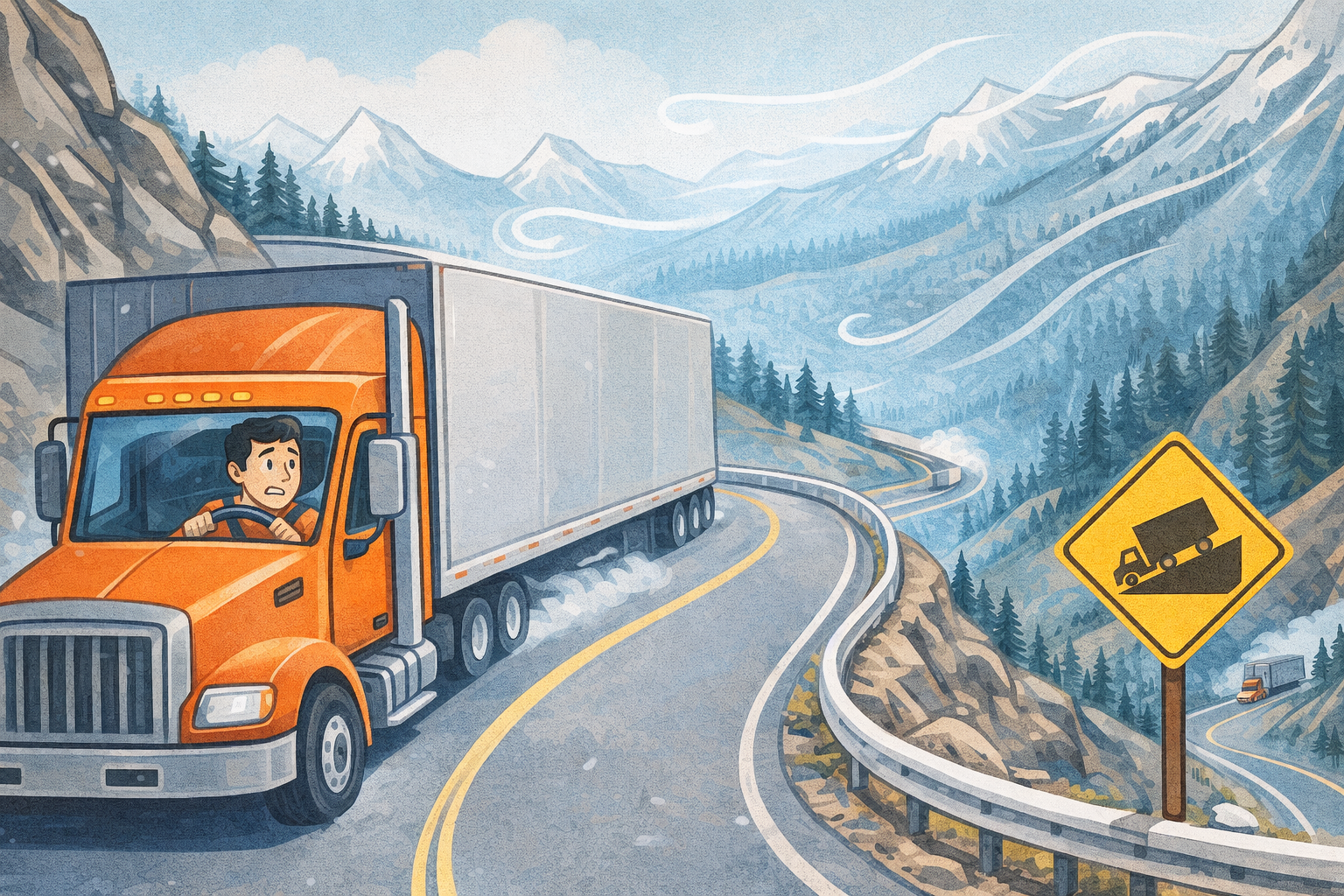
Honestly, the feeling of driving for the first time in a real mountain area which is totally different from what you learn in class diagrams, simulator hills, or training-lot practice. Longer and steeper mountain passes go with longer downgrades, thinner air, sharper curves, unpredictable winds, and grades punishing even small mistakes. Although the experience is unforgettable, but, it should be approached with patience, discipline, and respect for physics. Many of the new drivers who start their first steep route with the right habits learn things very quickly; whereas, the ones who rush to it often have to learn lessons in the hardest way. For many rookies, these feel like first mountain routes that introduce real CDL mountain routes far beyond what flatland training suggests.
Mountain trucking is strength not so much, but more of preparation that is the answer. Your decisions about going downhill before you start your first descent, speed, the position of the gear, load weight, and your braking strategy will determine if the next few miles are as smooth as you want them to be or will turn chaotic. A CDL, on the other hand, shows you are licensed, but mountain driving is about whether you are ready for real-world slopes with your instincts — especially when driving in mountains becomes part of your professional driving routine.
The Positive Feel of Mountain Routes for New CDL Drivers
The small changes in height often catch beginners off guard:
- Grades are longer than expected by most.
- Momentum builds quicker than when driving on flat ground.
- Turns seem closer than they are on the map.
- Trucks take longer to stop because of load and heat.
None of these should cause fears; only common sense is needed. Focus on mountain routes requires an even level of thinking rather than speed intelligence.
The Mountain-Driving Fundamentals Every New CDL Holder Needs to Build on
You must know these basic principles, which should be second nature:
- Set your speed before the grade, not during it.
- Once gravity takes over, it is nearly impossible to correct mistakes with a heavy load.
The gear you want should be chosen early.
Downshifting from high RPM to low is difficult; therefore, it is better to throw downshift when feeling the load — something every truck driver advice guide mentions for controlling steep grades and challenging routes.
Use engine braking as a principal tool.
Service brakes are just helpers; they are not able to bear the weight of the mile.
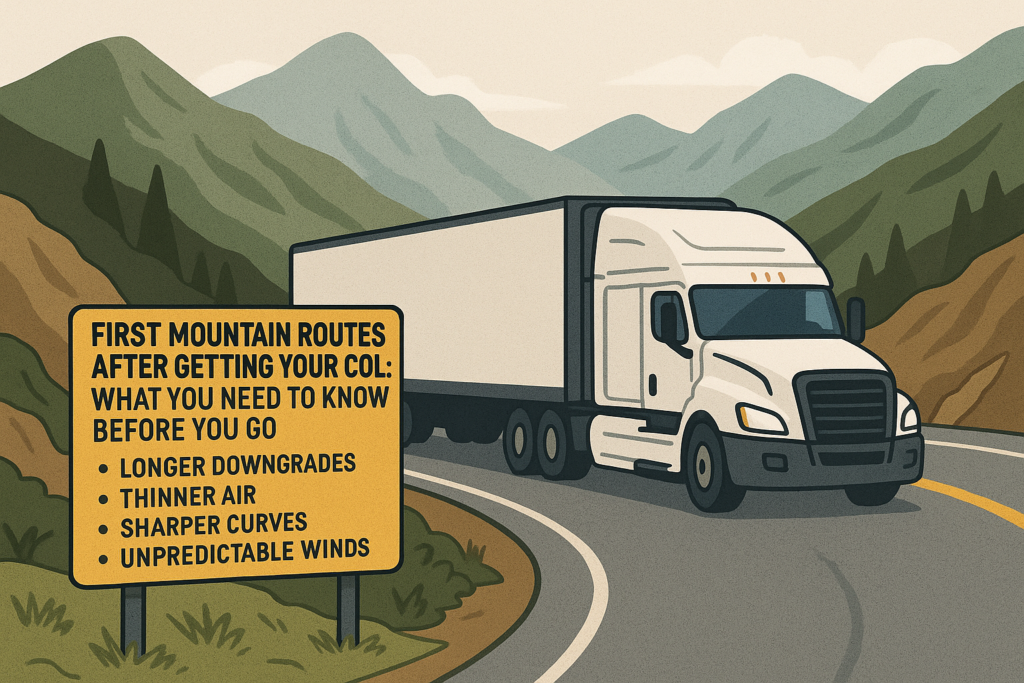
These three rules are the cardinal safe mountain trucking rules; they work regardless of the weather, load type, or road condition. They represent the foundation of mountain driving safety that every rookie needs before you go deeper into harder terrain.
What Beginners Expect vs. What Actually Happens
| Expectation | Reality |
| “I can slow down anytime.” | Brakes may fade long before the bottom of the hill. |
| “Steep grades are short.” | Many last multiple miles with no safe place to stop. |
| “Engine braking is optional.” | It’s essential — without it, brake heat becomes unmanageable. |
| “Curves are clearly marked.” | Mountain turns often appear sooner than expected. |
Pre-Descent Checklist Every New CDL Drivers Should Use
- Check brakes, air pressure, and warning lights.
- Confirm weight and trailer balance before entering the mountainous area.
- Review the posted grade percentage and the length of the road you will be driving.
- Choose the target gear while driving on the flat pavement.
- Communicate with dispatch if the route includes unfamiliar passes — especially mountain pass driving with unpredictable driving conditions.
This small routine can resolve most of the problems rookie drivers encounter on their first mission at the mountain.
Steep Downgrades: How to Stay in Control All the Way from the Very Start to the End
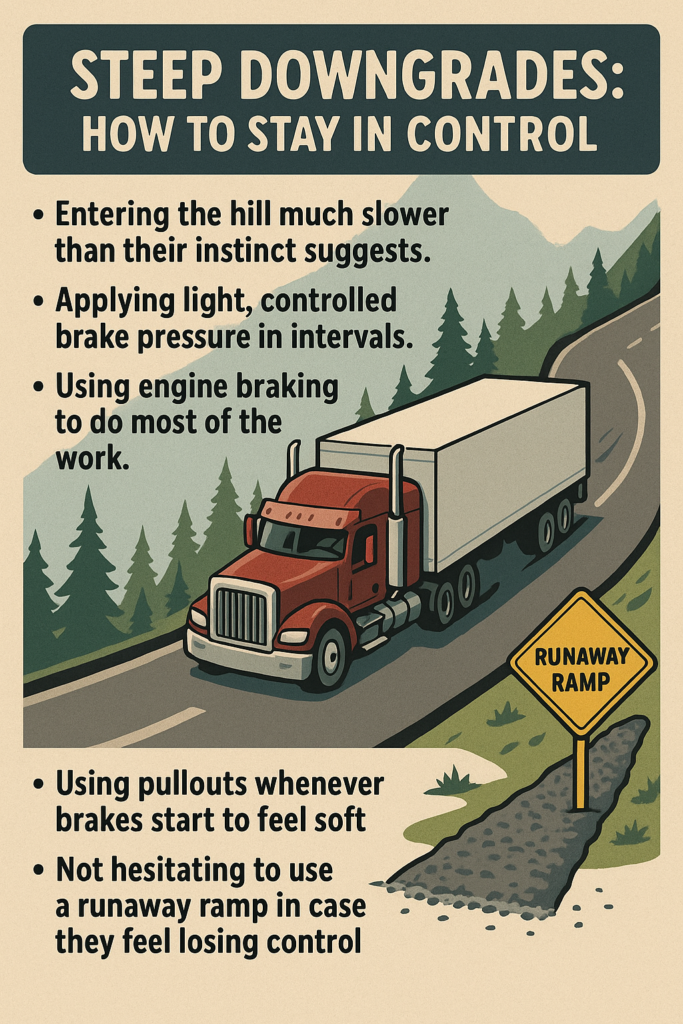
A steep downgrade by itself is not hazardous it’s only unmanaged speed that makes it so. Your truck is always going to try to go faster down the hill than it should. Therefore, your only job will be to not let unnecessary momentum build up.
What continues to keep beginners the safest is:
- Entering the hill much slower than their instinct suggests.
- Applying light, controlled brake pressure in intervals.
- Using engine braking to do most of the work.
- Using pullouts whenever the brakes start to feel soft.
- Not hesitating to use a runaway ramp in case they feel losing control — runaway ramps exist precisely because steep grades can overpower even experienced drivers.
Runaway ramps are known to save lives, and no company is going to penalize a driver for using one correctly.
Grade Percentages and What They Demand from the Driver
| Grade | What You Should Prepare For |
| 4–5% | Easily manageable for rookies if speed is set early. |
| 6–7% | Requires the engine brake to be firm and discipline lane control. |
| 8%+ | Dangerous for inexperienced drivers; recovery from mistakes is limited. |
| Long continuous ones | Main danger = brake temperature, not curves themselves. |
Why Engine Braking is More Important Than Most CDL graduates Expect
During the training, it may seem like engine braking is just a tiny feature. However, when you are actually in real mountainous territory, it will be your lifeline. For instance, using it:
- It slows the truck without overheating components.
- Through curves, it keeps you stable.
- It will not need emergency braking.
- You can think instead of react.
A driver that “rides the engine brake instead of the pedal” is likely to adapt to mountain work faster than others.
Common Mistakes New Operators Make on Mountain Passes
- Entering too fast because the top looks flat.
- Grades often begin subtly before dropping sharply.
- Trying to downshift too late.
- Once, RPM will escalate, then the gear box can only accept that one due to the height of the truck.
- Ignoring brake smell or early signs of fade.
- Pre-heating heatbuild room; turning at a turnout early saves no casualties.
- Assuming weight limits are suggestions.
- A trailer with too much load greatly changes the stopping distance.
The mistakes with decision-making become very vast in the mountain, but there is a way to avoid almost all of them through patience.
Three Practical Habits That Make Mountain Routes Easier for New CDL Drivers
- Look far ahead rather than just straight at the road in front of you.
- By seeing the next curve and grade ahead of time, you can safely adjust your speed.
- Use every advisory sign as a specific warning for your truck.
- Because mountain signage exists, there must be drivers that misjudge those curves.
- Treat every downhill run just like you are seeing it for the first time.
- Familiarity should never replace caution.
Stressful tasks are easily converted to controllable ones with the help of these tips.
The First Mountain Route Is a Teacher, Not a Test
Mountain trucking is a process where preparers are rewarded and hasty ones are punished. Your first mountain pass might be extreme, but intensity is not danger – it is just information coming to you quicker than usual. Make sure that you follow the grade up to the top of the mountain with precision, trust your core principles, and let the mountain lead you instead of you struggling to control it. These early CDL mountain routes shape how you will handle future truck routes, especially the more challenging routes you’ll meet later in your career.
Becoming a capable driver, like many veteran mountain drivers began their journey, requires one careful descent at a time.
High winds – They could cause the trailer to become unstable, especially in the exposed ridge sections.
Altitude weather shifts – Fog, snow, or rapid temperature drops that affect traction are fast.
Sharp switchbacks – Prevent off-tracking lower gear, wide setup, and slow entry.
What CDL Training Doesn’t Completely Prepare You For
CDL training is built around the introduction to engine braking, downshifting, and right mirror disciplines. However, for timing issues, real mountains are the best teachers. Feeling like you are pulled downhill is a phenomenon that no classroom is able to imitate. The rookie truck drivers quickly figure out that a truck behaves like a rolling physics lesson: load weight, RPM range, gear choice, brake temperature all interact.
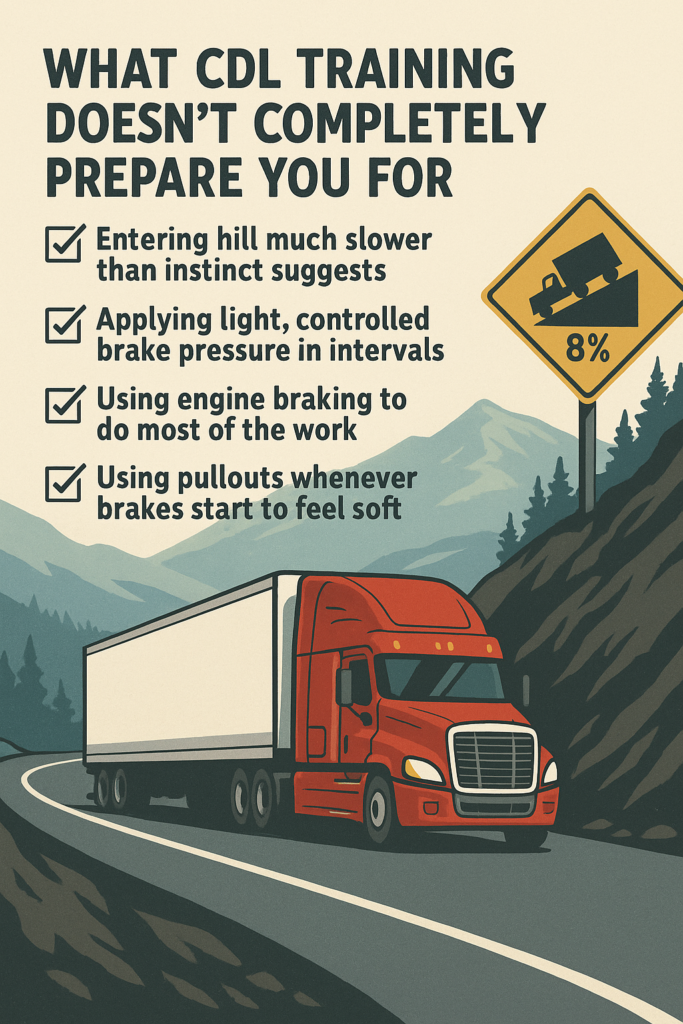
Starting from the basics, the first mountain pass for an amateur driver is not proving your bravery, but rather showing your skills in preparation — the core of what to know before you go.
Checklist: What to review before entering a mountain route
- Check air pressure, brake condition, and trailer weight
- Verify fuel level – idle and engine brake use increase consumption
- Map preview for grade percentage and length of descent — part of any careful pre-trip inspection
Gear & Speed Guidelines for Beginners (Generalized)
| Grade Type | Approach Speed | Recommended Gear Behavior |
| Mild (3–4%) | 45–55 mph | Light engine braking; minimal foot brake use. |
| Moderate (5–6%) | 35–45 mph | Downshift early; maintain steady RPM for control. |
| Severe (7–10%) | 20–30 mph | Lowest safe gear; heavy reliance on engine brake; brake checks. |
Note: Always follow the vehicle manual and posted road signs.
Why Engine Braking Is Your Best Friend at Mountain Levels
Each new CDL driver is sometimes afraid of running at high RPMs, therefore, they do not use the engine brake frequently enough. Nevertheless, on the mountains, the engine brake and selecting the right gear will give brake fade, a dangerous condition where brakes overheat and lose stopping power, no chance. Improper brake technique is almost always the cause of runaway trucks, not bad luck.
Rule:
If your brakes are smelly then it means you are already too late, so next time slow down before you hit the descent.
Three rookie mistakes that cause the most trouble
- Choosing a gear after starting downhill instead of before
- Following cars too closely, leaving no space to stabilize speed
- Ignoring weight impact — heavy loads require drastically more control
These actions turn manageable descents into stressful, dangerous events.
The Confidence Curve: When Mountain Routes Finally “Click”
Every new CDL driver reaches a moment where the mountains stop feeling unpredictable and begin to feel rhythm-based. You watch the signs earlier, adjust gears instinctively, and understand the “push” of the trailer on curves. This shift from reaction to anticipation is the hallmark of a developing professional driver.
Mountain driving is not about fear — it is about control.
And control comes from repetition, not bravery.
Final Thoughts: Your First Mountain Route Sets the Tone for All Future Ones
Ascending or descending your first mountain pass as a newly minted CDL driver is a significant achievement in the development of a commercial driver’s license. It witnesses habits, forms judgement, and teaches a healthy respect for the land. The mountains don’t rush, and neither should you.
What you build during these early runs — your calm choices, your attention to the truck’s behavior, and the way you apply small but meaningful truck driving tips — slowly becomes the foundation of professional driving. Over time, these quiet lessons shape the instincts that keep drivers steady on steep grades, unpredictable curves, and long descents.
Your first mountain route is not just a milestone; it is the beginning of a driving mindset that stays with you throughout your entire career.