
People who just enter logistics often worry about only one thing far more than loading times, brokers, or rates: what should they do to speak like everybody else does? The supply chain world is highly fast, the shippers respond in short burst, the receivers ask for clarity, and a beginner just has only seconds to sound confidently. Professional communication is not about complicated jargon of the industry; it is about a format of shipping messages that are predictable, clean, and easy to understand. When you use a language that fits the rhythm of freight forwarding, you get the trust of others sooner — especially when these early writing messages slowly turn into your own natural message templates.
Beginners frequently stick to the habit of just one-line greetings or overly-done paragraphs that seem different from being read like transport messages. Banning hyperboles is the right way for you: speak professionally, and avoid theatrical language. Here business messages aim at the simple format of confirming requests, updating information, or closing the loop without causing confusion — the core of any beginner guide to shipper receiver communication.
First template is, of course, the one that both shippers and receivers expect but never say directly.
Problems with common message flows that beginners face
• requesting or asking about load availability
• confirming pickup times, dock numbers, or paperwork
• informing about delays, traffic, or early arrival
• keeping out misunderstandings before problems arise
These trivial encounters differentiate your reputation far more than just one word-perfect email. Therefore logistics communication consists of three main rules: clarity, timing, and tone — a trio that sits at the center of even the simplest logistics templates.
Simple templates which really work
Beginners frequently seek “professional email templates,” and they usually find those which are too corporate for freight messages. Below are the forms that professionals really use every day when writing messages in shipping contexts.
Requesting load details (shipper)
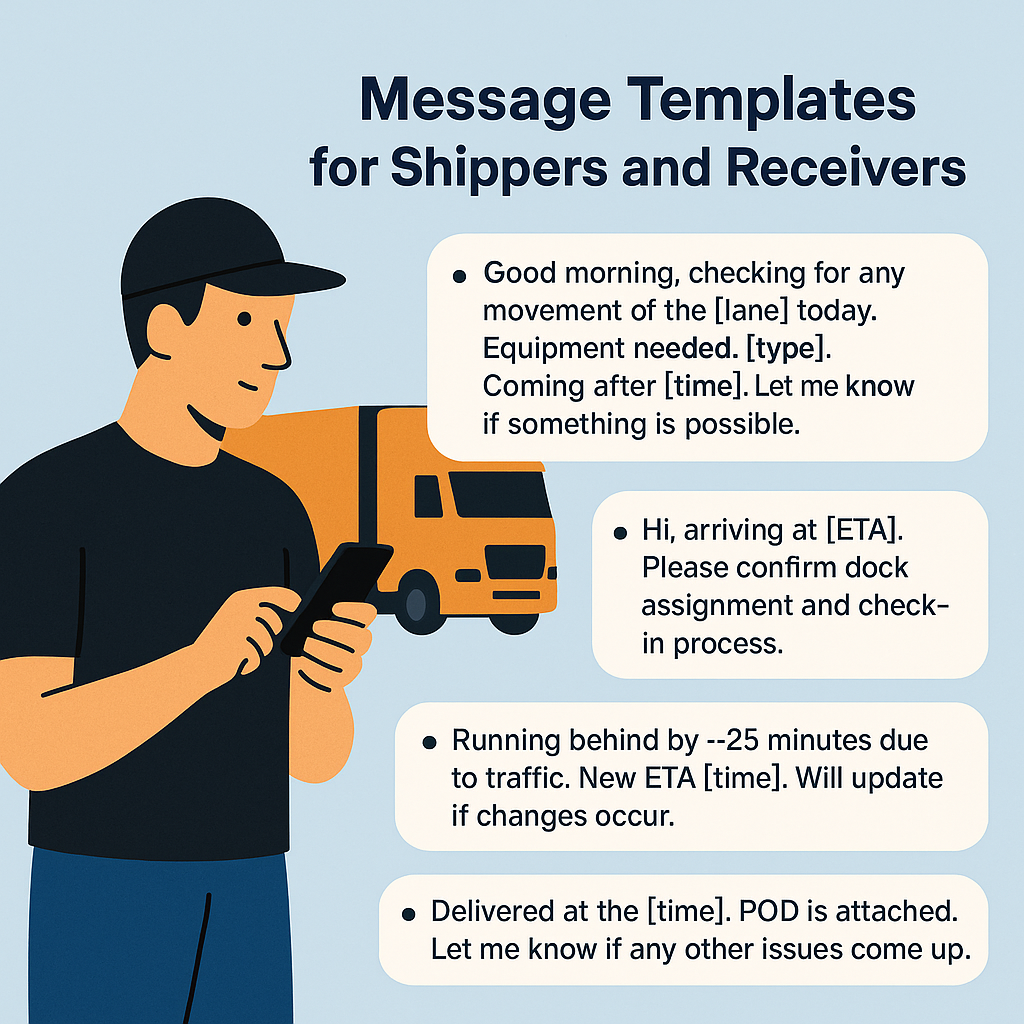
“Good morning, checking for any movement of the [lane] today. Equipment needed: [type]. Coming after [time]. Let me know if something is possible.”
Confirmation from receiver
“Hi, arriving at [ETA]. Please confirm dock assignment and check-in process.”
Delay report
“Running behind by ~25 minutes due to traffic. New ETA [time]. Will update if changes occur.”
Delivery communication — closing out the load
“Delivered at the [time]. POD is attached. Let me know if any other issues come up.”
These messages are brief since the industry values time and not story-telling. Simplicity should be the primary focus of the beginner’s guide; only later on, the guide can cover refinement.
Summary: habits to create professional-sounding messages
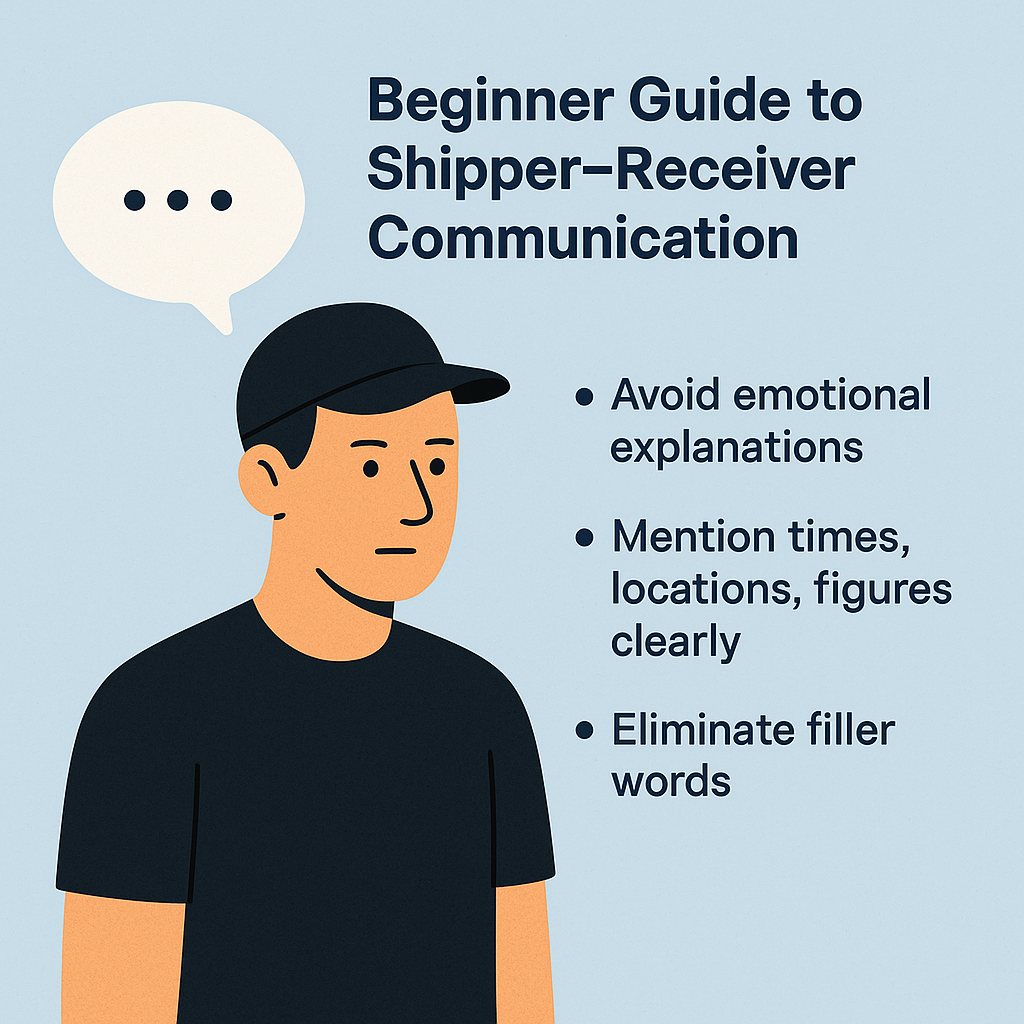
• avoid emotional explanations — stick to facts
• mention times, locations, and figures clearly
• eliminate filler words; templates work better when each line has a purpose
• read your message over once before sending it — typos can change meanings quickly
• confirm anything unclear instead of guessing
These are simple communication abilities yet they massively impact the quality of your freight messages and shape long-term professional communication habits.
Small table: common phrases versus better professional language
Communication Table 1
| Casual phrase | Professional alternative |
| “I believe I’ll arrive at around…” | “ETA is [time]. Will update if changes.” |
| “Any loads today?” | “Checking for availability on [lane] for today.” |
| “I could come late.” | “Running [X] minutes behind due to [reason].” |
Communication Table 2
| Situation | What shippers/receivers expect |
| Early arrival | Politely notify — do not surprise the dock |
| Delay | Honest update with new ETA |
| Confusion | Ask directly — guessing costs money |
With such modifications, a beginner would be able to speak professionally without sounding robotic.
The Ultimate Guide to Conversations with Shippers
Small guide to industry terms without overdoing them
Freight forwarding uses simple repeatable terms: ETA, BOL, POD, pallet count, detention, layover, deadhead. A beginner does not have to memorize a whole dictionary of industry terms; using separate ones in the right context is efficient; thereby the person shows competence. If they are not used, the language would seem somehow abstract and confusing, especially in the case of receiver templates where people expect short transport messages that match the speed of operations and reinforce reliable delivery communication.
Why this is more important than what beginners think
Carriers, warehouse staff, dispatchers, and brokers undergo a lot of processes daily which on their part pour hundreds of transactions. When your writing has been consistent, respectful, and clear, you eliminate friction for everyone and that is being noticed. Displaying a clean message is a form of reliability that is established long before the record of your driving or service does. Supply chain communication is a skill, not a talent, and the early birds will always reap the benefits.
Industry insight:
A similar approach to structured, predictable communication is also emphasized by RJ Logistics, who note that shippers rely heavily on clear, timely updates and simple message formats that reduce uncertainty during freight operations. https://rjlogistics.com/freight-brokerage-best-practices-smart-shippers-demand-effective-communication/)
How rookies can maintain an air of certainty even when they feel otherwise

The main difficulty faced by new entrants is not what they want to convey but rather the confusion that arises at the start of their writing. Fresh entrants in logistics are often caught in a dilemma; should they be worried about whether to speak grammatically correct? The fact of the matter is that shippers and receivers do not mind much about language but they are extremely concerned about the movements of their freight. It is very much easier to communicate professionally, particularly in shipping messages, when one swaps the apologetic tone with the informing one.
Instead of “Sorry, I just want to ask…”, try:
“Checking on the following detail before arrival:”
Instead of “I’m new, please correct me if I’m wrong…”, try:
“Confirming to avoid misunderstanding:”
Three small habits that help immensely:
• place the key information in the first line, never at the end
• specify the context (“pickup”, “delivery”, “ETA”, “dock”) instead of vague questions
• close the message with a small confirmation (“Will update”, “Standing by”, “Received, thank you”)
Such micro-skills turn a new worker into someone who reads the rhythm of supply chain communication instead of interrupting it — the essence of practical logistics templates.
Mistakes beginners make when writing to shippers and receivers
Every industry has its own set of regulations that new entrants may omit by mistake. Logistics problems mainly arise from misappropriation of the tone, timing, or details. The examples below are mistakes made by new drivers, dispatchers, and warehouse assistants, but they can be easily corrected once people recognize them.
• sending long paragraphs instead of a quick one-sentence update the receiver is expecting
• forgetting to include the pickup numbers, BOLs, or reference IDs
• using emotional language (“this is stressful”, “I’m frustrated”, “I hope this works”)
• writing in casual slang in professional messages
• delaying updates because you “want to be certain first” — the silence hurts more than the uncertainty
The answer is not acting like a robot, but rather learning the equilibrium: direct, correct, and neutral communication. Most shippers and receivers reply quickly to models that do not waste their time.
Comparison table: beginner mistakes vs. better versions
| Beginner mistake | Better professional version |
| “I’m here, what do I do now?” | “Checked in at gate at [time], requesting dock instructions.” |
| “You guys didn’t tell me where to go.” | “Could you confirm dock assignment for pickup [number]?” |
| “Stuck in traffic, sorry.” | “Delay of ~18 minutes due to traffic. Updated ETA: [time].” |
A novice’s edge: why professionalism in communication catches up with experience faster

The most fascinating aspect of logistics is that the ability to communicate does not depend on the time spent on a job. A newbie mastering the art of writing precise and structured shipping messages will be able to do this better than a colleague with ample experience but with poor communication skills. As a matter of fact, it is the shippers and the receivers who notice your professionalism not by the amount of industry knowledge you possess but by the clarity with which you write your daily tasks — the subtle backbone of all message templates used in modern freight operations.
The professional language is just a tool for the discipline of providing certain information only when needed. The templates that you are using now — ETA updates, delay notes, delivery confirmations, and reference-number requests — will all become second nature someday. With every new message, your tone becomes more constant, your writing is more assertive and your knowledge of technical terminology expands automatically.
If you are new, then it is not a disadvantage. It is exactly the time when you can set up good habits for yourself without allowing bad ones to settle in. Apart from that, logistics is the field where you will be rewarded for your good communication skills: fewer misunderstandings, quicker responses, stronger partnerships, and a better daily workflow altogether. By treating each message as a small effort of clarity, you will sound as a professional much earlier than you will feel like a pro.
FAQ – Practical Expectations for Newbies Messaging Shippers & Receivers (Extended Edition)
1. Is it necessary for a beginner to send updates even if there are very minor changes in time?
Definitely yes. A decrease in the expected arrival time by just a couple of minutes can have a more significant effect on the dock scheduling than most learners realize. The shippers and receivers would rather have micro-updates than surprises because this makes their workload reallocating much easier.
2. Do shippers want a greenhorn to grasp all logistics terms at once?
Not by any means. Their only expectation is to the point. The use of terms such as ETA, BOL, pallet count, or dock number without mistake at the outset is sufficient. Being precise has more value than making an effort to sound too technical.
3. Is it professional to seek confirmation in cases of uncertainty?
Not really. It is just the opposite. A direct clarification of a question can prevent making mistakes like waiting at the wrong gate or not being able to pick up under the intended time. The clear questions sign reliability but not "weakness".
4. Should the inexperienced drivers follow the pattern of very short messages sent by veteran drivers?
Yes, but only after verifying that the necessary information is included. Short, structured lines (“ETA 14:20, traffic slowdown, will update”) are the language of the industry and help operations teams avoid delays.
5. What type of message do receivers respond to the most?
Concise, factual updates. Receivers juggle dozens of inbound trucks, so messages that include time, purpose, and request in one line typically get the quickest replies.
6. Does the tone of the messages impact the view of shippers towards a newcomer?
Certainly. The neutral, calm language creates the trust in the initial steps. People taking on or releasing freight respond better to the stable language than to the emotional or sorry ones. The tone becomes, in a way, part of your professionalism.
7. Should a newly minted driver always be the one to tip off the dock by saying ‘Hey I’m early!’?
Yes. Early birds can really disrupt the entire staging if they have no notice about arriving. Just one brief note (“Early-arriving, ETA 09:45 – please confirm dock”) averts any confusion and makes it to the spot unhindered.
8. Can poor communication lead to the loss of future load opportunities?
Yes, indirectly. The habit that carriers develop to monitor interactions and shipper remembers which of the dealings with them were the easiest. It is the building up of the long-term advantage for the person starting a career in logistics by regularly applying precise updates.