
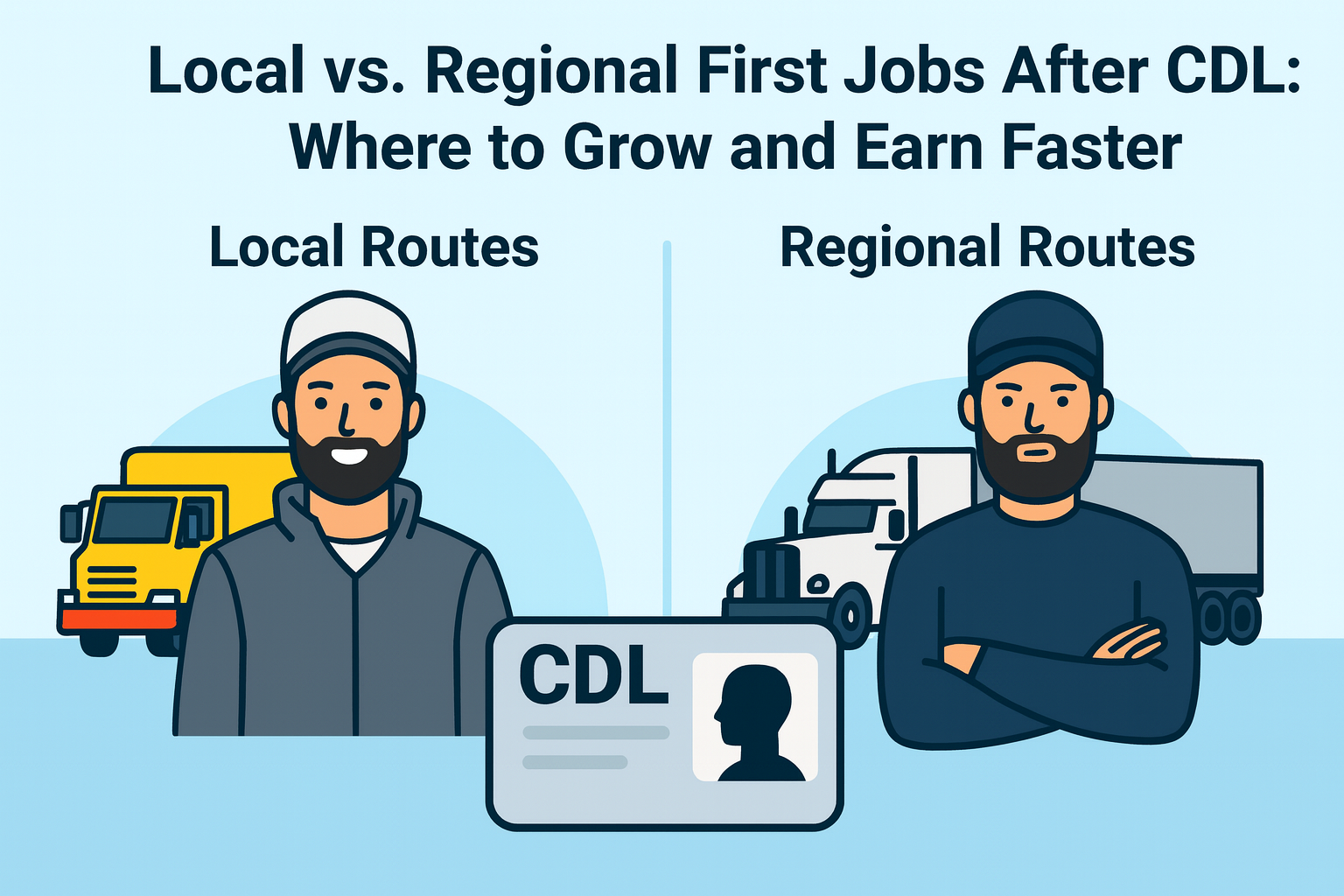
Begin your truck driving career after earning your commercial driver’s license. This is a time when you can finally practice everything you have learned in training in the real truck driving world. For many new drivers, the first step is to go to the company as a driver with a valid commercial driver’s license (CDL) without knowing much about the differences between local trucks and regional trucks. They are not fully aware of the importance of these aspects for the entry-level CDL salary, truck driver career opportunities, and trucker lifestyle, respectively. The first truck driving job influences the generative level, pace of growth, and skill acquisition of the driver, as well as the possible later trucking job outlook — especially when comparing local routes with regional routes and what each means for long-term progression.
Local truck CDLs can overlook key factors if they focus only on getting home daily or being on the road for a few days at a time. Local routes actually offer distinct lessons. Local routes introduce drivers to different freight flows, instill different habits, and steer their careers in different directions. Making the right choice first makes drivers make more money, gets them on the fast track, and simply helps them from getting stuck in a lane with limited opportunities — something that shapes real earning potential early.
First, CDL job is not only important for salary but also for everything else what is going to happen in the future. It is a really important event that creates an initial framework for your future. Recruiters and carriers who are going to look at you are going to be interested in your miles, discipline, safety record, and reliability during your first 6, 12 months. Your choice of a local or a regional position also determines:
- how fast you get acquainted with variable road environments
- how many miles you log in the first year
- if your CDL driver’s pay goes up sooner or not at all
- the type of freight you will qualify for
- when your truck driving income starts going up and how much do CDL drivers make over time
- career prospects in the business, including job growth and access to better CDL driver jobs
Developers who carefully make decisions are able to benefit from faster pay rises, better job options, and wider access to positions. The opposite can happen to those who are stuck with little income or fewer opportunities because they mismatched their primary goals with their first choices.
Local CDL: Predictable Schedules and Short Learning Cycles

Local CDL work is said to be stable, and that is why many newcomers want it: there are routine roads, shorter drive times, and back home every day. There is a lot of hourly pay and little mileage pay. Local CDL roles usually appear in industries like food distribution, retail delivery, waste hauling, construction supply, and similar sectors. While the income is steady, it is usually not the highest, especially compared to regional or over-the-road positions. For many, it is not always the best first trucking job, but it is a reliable one.
Local driving builds foundational skills very quickly:
- getting around a congested city
- a lot of backing, alley docking, and power-style turns
- customer contact
- tight delivery window management
- stop-and-go cycling that never ends
Local CDL Snapshot
| Category | What to Expect |
| Pay format | Hourly wage + overtime |
| Annual earnings | $45,000–$62,000 for new drivers (annual salary baseline) |
| Home time | Every day |
| Skills developed | Backing, city navigation, communication |
| Stress | Moderate to high due to traffic |
| Growth potential | Slow early income growth but high stability |
Local driving is best for the ones who are in need of steadiness but may miss the chances of getting huge raises early in their trucking careers.
Regional CDL: More Miles, More Variety, Faster Growth
Regional CDL routes go through several states and keep drivers on the road for 2 to 4 days. These jobs are a compromise between staying at home and earning more. The new CDL drivers who want to make more money quickly find the regional work the best truck driving career.
Regional work consists of:
- higher mileage pay
- accessorial bonuses
- exposure to different weather systems
- more highway experience
- early qualification for specialized freight
- faster development of discipline and route planning — a path for drivers who want to start growing career faster
Regional jobs stand between local and over-the-road jobs, which provide better driver salaries without the need for weeks away from home. For many, regional routes become the turning point where income and skills begin to accelerate.
Regional CDL Snapshot
| Category | What to Expect |
| Pay format | Cents-per-mile + extra pay |
| Annual earnings | $58,000–$82,000 for new drivers |
| Home time | Weekly or every few nights |
| Skills developed | Trip planning, highway safety, weather readiness |
| Stress level | Moderate, fewer tight maneuvers |
| Growth potential | Strong and fast |
Local vs. Regional Pay: Where Do New CDL Drivers Earn More?
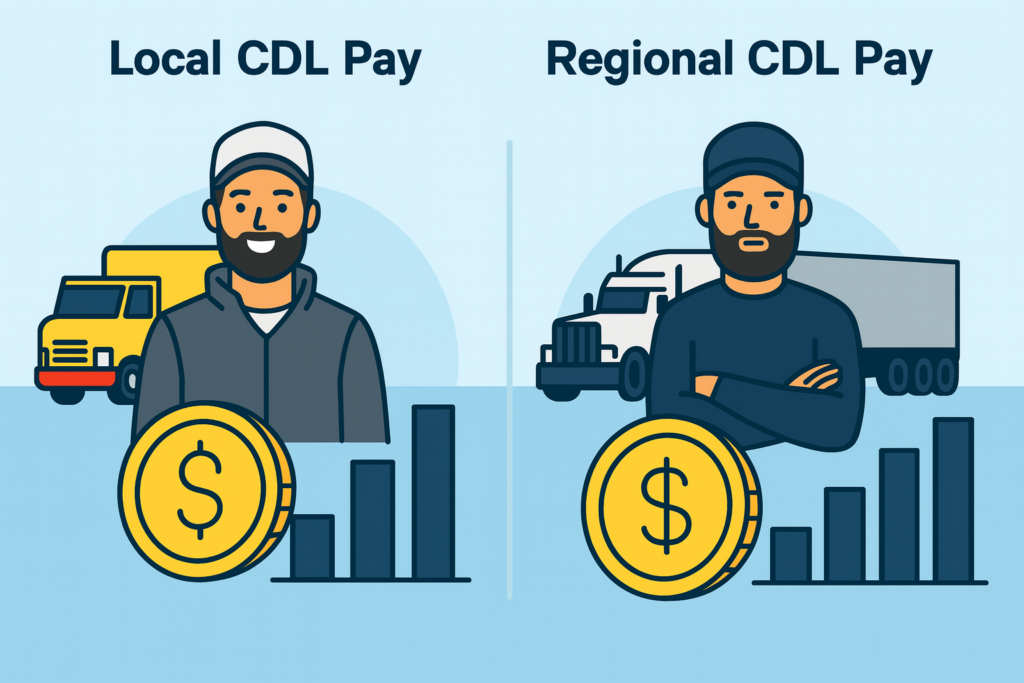
So as to grasp how much do CDL drivers make in each category, it is not enough to check the base rate. Local drivers work a lot more hours navigating loading docks, traffic jams, and slowdowns. Regional drivers simply spend more time actually driving which translates to more paid miles — a direct boost to truck driving pay.
Entry-Level CDL Salary Comparison
| Pay Component | Local CDL | Regional CDL |
| Base pay | Lower hourly rate | Higher CPM |
| Annual income | $45k–$62k | $58k–$82k |
| Overtime | Common | Less common |
| Bonuses | Small | Often large |
| Income growth | Slow | Fast |
Regional CDL roles usually pay the most for the first year for those drivers who want to have their careers flourish.
Which Job Helps New Drivers Grow Faster?
Skill development is one of the major factors that differentiate local from regional work. Regional CDL routes make drivers learn how to drive for a long time, in different weather conditions, on roads they don’t know, and make them navigators in the real world. This practical experience gets you faster into high-paying jobs like tanker routes, specialized freight, and advanced regional/OTR.
Local work helps develop the technical skills and confidence, especially in navigating tight city spaces. Those skills will be the foundation for jobs like LTL, city delivery, or local tanker work. However, sometimes income increases faster in regional posit
Why Local CDL First is Some Beginners’ First Choice?
the wish to go home every day
the convenience of hourly pay rather than mileage pay
the intention of learning the backing skills at the very beginning
the ambition of taking part in LTL or city driving roles the choice of a structured and predictable routine above anything else
Why Some Beginners Choose Regional CDL First?
goal to increase driver income faster ,interest in broad, diverse driving environments , preparation for future specialized freight , desire to build miles and reputation quickly
access to performance bonuses unavailable in many local positions
The Hidden Factors That Affect Driver Income
Many new CDL drivers believe that base pay is all that counts. But in fact earnings greatly depend on:
- weather conditions and road types
- shifts available
- freight cycles as well as seasonal impacts
- dock wait times
- carrier’s network efficiency
- drivers’ metrics such as fuel and safety
Two drivers with the same title and the same job, but who choose different paths, can end up with completely different annual incomes — a reality many new applicants don’t realize when comparing CDL driver jobs.
Common Mistakes New CDL Drivers Make
Newly licensed drivers cut their futures very often by making such mistakes as the following:
- choosing a job based only on home time
- misunderstanding how driver pay is calculated
- assuming an hourly wage always pays more than mileage
- not thinking about long-term earnings
- accepting the first offer without comparing options
- not looking at driver salary comparison across regions
How Each Path Shapes Long-Term Truck Driver Careers
Local CDL Career Path
City delivery → LTL → dedicated lanes → specialized local freight (tank, hazmat, etc.)
The increase is slow and steady.
Regional CDL Career Path
Regional → OTR → specialized freight (flatbed, tanker, heavy haul)
The increase is typically a lot faster, especially if the new drivers are motivated.
What Recruiters Don’t Mention (But You Should Know)
Recruiters usually highlight sign-on bonuses, home time, and surface pay. They hardly ever cover:
- how much unpaid time local drivers accumulate
- how regional exposure accelerates skill development
- rule of regional experience for higher CDL driver pay at long term
- how freight cycles affect new drivers differently based on role
These factors often shape long-term earnings far more than drivers realize.
Final Thoughts: Which First CDL Job Should You Choose?
Local and regional CDL jobs can both lead to lucrative truck driver careers. The catch is making the choice suit what you want to get out of your first year.
A local CDL job would be a solid choice if stability, daily home time, and structured schedules are your top priorities.
If your main aim is to maximize income, gain confidence quickly, and prepare for high-paying freight later, the regional CDL routes are a better choice that will get you on the fast lane and build the best momentum at the initial stage.
Next to the finish line your first trucking job is not the end. It is the beginning that sets the level of your truck driver career. Pick out the lane that raises and not only the one that feels safer on the first day.
Mini FAQ: Local vs. Regional CDL Jobs — Quick Clarifications
1. Is it true that accepting only a local CDL job at the beginning takes a toll on long-term income?
Not necessarily, but the speed is slower. Local routes boost one’s technical confidence quickly, yet new drivers usually get the mileage-based growth and early bonuses faster in regional work, thus effecting their income earlier.
2. Do regional CDL routes always have to pay more for neophytes?
In most occasions, yes. Regional drivers log more paid miles and learn the skills than qualify for high-paid freight earlier. But, stable hourly income in the local jobs might attract those drivers that prefer the set routine.
3. Is it really that hourly pay is the best option for beginners who want to be sure about their wages?
It may—provided that the stability of home time and schedule is more important than the fast earnings. Thus, mileage-operated regional salaries usually exceed that hourly rates as a result of a driver’s gaining speed, precision, and route knowledge.
4. Should new drivers be concerned about not knowing which to choose first?
Definitely not. The actual blunder lies in choosing without comprehending how both jobs influence the skillset, career, and the future CDL options. Right lifestyle choices with clear goals, and earning expectations directly proportionate to the right start.