
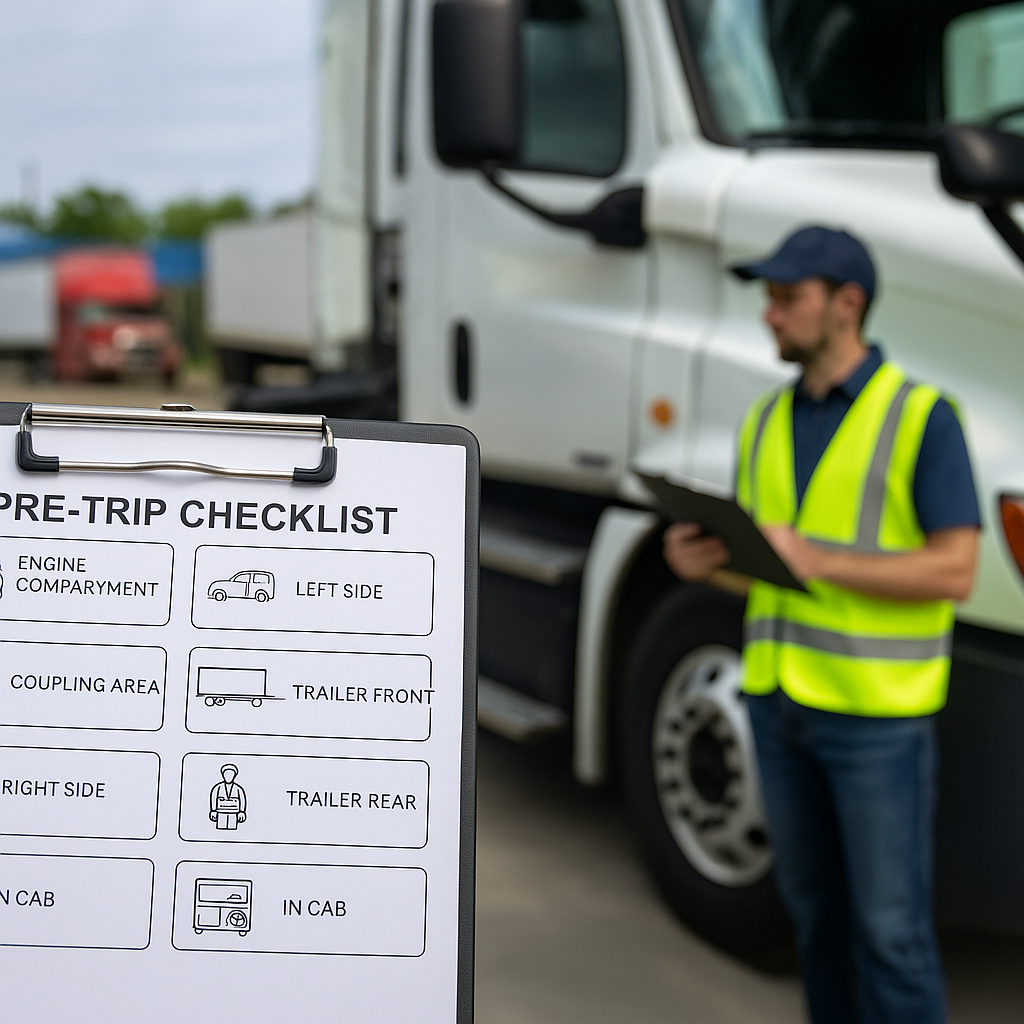
The pre-trip inspection is the first major hurdle that every novice truck driver must overcome in order to enter the world of commercial trucking. The pre-trip checklist, often treated as a kind of beginner checklist by many students at truck driving school, is not just a disciplinary measure; it is also a manifestation of the driver’s adherence to safety protocols, being accountable, and mechanical knowledge. Besides, examiners often see it more as a measure of pre-learning readiness than the written CDL test or any early driving test attempts. To many people, an inspection may sound like a memory test but in fact, it is a practice to be performed for safety reasons in order to be certain that everything is safe; be it the equipment, the driver, or the pedestrians.
Without a doubt, it is the single most vital procedure for a novice driver, since it sets up the path for good practices throughout their whole CDL career. A driver who honors the pre-trip checklist is a responsible and disciplined individual; whereas, a careless practice could lead to repair issues, DOT violations, and sometimes safety threats that could have been spotted by the correct vehicle safety inspection. The primary theme of this article is the explication of the pre-trip inspection steps and actual inspection checks, while the secondary objective is a practical way for the learner to build self-esteem by being capable to perform the matter at hand according to the pre-trip requirements and mandatory checks expected in driver training.
Why It’s Worth At The Beginning Stages: The Pre-Trip Inspection
To be specific about the pre-trip, it is buried under the significance of this idea of being like the heart and driving on to the metaphor of the body. The inspection of the vehicle is the vehicle driver’s number one line of defense against failures and breakdowns. An FMCSA study evaluated numerous violations that could have been evaded if mechanics had found obvious problems, for instance, a leak in brakes, worn tires, missing lights, or suspension problems — issues that could be detected during a commercial vehicle inspection or even a simple beginner guide walk-around of inspection items (as documented in the FMCSA Large Truck Crash Causation Study: https://www.fmcsa.dot.gov/safety/research-and-analysis/report-congress-large-truck-crash-causation-study).
For your CDL examiners, your capability to sense problems is way more than only an examination; it reflects that you are conscious of the burden of driving a vehicle with a weight of 80,000 pounds. Likewise, the instructors see you are thinking like an inspector when you apply the decent inspection logic. It is the likely prediction that you are going to keep on making the right decisions. When unqualified drivers have a meeting with experienced specialists to the question how essential is pre-trip checklist, or how to pass pre-trip confidently, the answer is straight and clear, – “It keeps you alive.”
What Inspectors Are Actually Expecting of a New Driver
Most of the students think that the CDL pre-trip inspection is like an interrogation on excessive and oversize technical terms but, to the contrary, it is a systematic and highly structured process that inspectors welcome instead of perfection. The only crucial decision is to pronounce the proper inspection words:
- properly mounted and secured
- not cracked, bent, or broken
- no abrasions, bulges, or cuts
- no leaks
- no excessive wear
These phrases indicate that the driver is not only familiar with the vehicle parts but also is knowledgeable about their safety values and understands what inspectors check during an early truck inspection.
Inspectors also want a repeated construction. The uncoordinated or random inspection will be interpreted as the lack of professionalism and it will also increase the risk of losing main points in the inspection. A truck inspection done correctly is thorough, going from the front, to the back, to the top like the way that CDLs instructors perform pre-trip checks in most states, especially when teaching a beginner driver preparing for the driving test and mandatory checks.
The next priority for the inspectors is the safety-critical systems that are the basic systems which must be in an order. For instance, if a novice child attempts to say the names of the parts that are hard, they can still show a firm grasp of the basics of safety by strong knowledge of the braking system, coupling system, suspension, steering, and tire tread depth — all of which are essential inspection items.
Initiating Inspection: The Approach and the Initial Visual Assessment
The most frequent mistake made by new drivers is thinking that the initial walk-up is unimportant. Yes, the truck inspection is said to start before the driver gets a hold of the hoses or the belts. As they approach the truck, the instructor wants to see the driver check the general condition starting from the level of the truck to the visible fluid leaks under the engine, any cracked or damaged marker lights and whether the windshield is in a good condition or not. This also includes simple light inspection moments that many beginners overlook.
Examiners often quote that they can gauge a student’s preparedness within a minute. For example, if the driver only arrives at the engine compartment with no concept of leaks and missing structural items, it is reflected by the lack of situational awareness. In the contrary case, driver’s victory in the opening act is achieved by a deliberate full-body scan, it is a sign of professionalism and it is related to the safe commercial driving mind and overall driver training approach.
The Compartment of the Engine: The Clue Is Understanding
For novices, the engine bay looks like a mix of belts, clamps, hoses, reservoirs, and steering components that crowd the space. CDL instructors are adamant that individuals learn to relax by looking at the systems that are being tested as opposed to just memorizing the parts that are not being used in their beginner checklist. CDL Pre-Trip Inspection Part A | Front of Vehicle + Engine Compartment (2025 DMV Test Guide)
For the driver who is checking the cooling system, the first step is the radiator, coolant reservoir, hoses, clamps, and water pump. The logic remains the same: the components must be securely mounted, free from leaks, and working properly. The same system logic applies to the power steering pump, the air compressor, and the electrical charging system. Rather than listing out all the parts mechanically, the driver is conveying the main job of every system respectively and showing understanding of actual inspection checks.
This kind of reasoning is the mature way of thinking and it makes the pre-trip checklist easier to handle. By a simple visual check, the inspectors can notice if the student is a beginner or someone experienced.
Safety of Mechanical Parts: Steering, Suspension, Brakes, and Wheels
Safe commercial driving should be about these areas — the steering, load braking, and road stability — and that is why they are necessary. They summarize the vehicle’s capacity to maneuver, hold weight, slow down, and be stable on the road. A young driver who deeply understands these systems will do well not just in the CDL test but also in the future driving career.
Steering components must be secured, and they should never have cracks or looseness. Loose play could sum up to a safety issue of great proportion. Suspension parts like leaf springs, hangers, shocks, bushings, U-bolts, and airbags have to be whole and should not move in a strange way. These sections are one of the most frequently DOT cited areas which is why they are well known.
Attention to brakes, especially air brakes, is a must. The student should not only find the brake chambers, slack adjusters, pushrods, brake drums, and lining but he should also mention what makes them defective. Air brake checks are among the most severe sections of the CDL test and represent some of the most important mandatory checks.
Wheels and tires should always be inspected for tread depth, inflation, rim condition, lug security, and hub seal leaks. This is the basic yet crucial part of it since tire failures have always been the main cause of commercial vehicle accidents and essential in what inspectors check on any driving test preparation.
In-Cab Inspection and Functional Safety Testing
In the cab, the inspection now proceeds from structural to systems: mirrors should be correctly adjusted, the windshield should be clear, and the seat belt should be in working order. Gauges (oil pressure, coolant temperature, voltmeter, and air pressure) should indicate the appropriate rise of values after the engine is started.
During this phase the air brake check readies for pressure accumulation, malfunction warning systems, and parking/service brake integrity. However, beginners do not often elucidate each step clearly and distinctly and sometimes they would pass the time with simple breathing examples as they blow in and out, resulting in missing the governor cut-in and cut-out demonstrations. This also affects the beginner guide understanding of how to pass pre-trip consistently.
The Coupling System: The Most Common Trouble Zone for Beginners
The coupling system is usually where most of the beginners are challenged. Knowing that the tractor-trailer couple together is incredibly deep, hence, it involves more than just a series of words like fifth wheel, apron, kingpin, and locking jaws. The inspectors want to hear candidates understand how these systems come together and what role they play in making them secure according to actual inspection checks.
Loose airline fittings, broken gladhand seals, or improperly seated kingpins can undo the whole joining of the tractor and trailer. A top driver is one who grants the understanding of how to avoid the trailer from separating from the rest of the rig. That is a trailer separation which constitutes a safety hazard in the trucking industry.
Trailer Inspection: The Other Half of the Truck
In its structures, braking, suspension, and lighting systems, the trailer brings its systems. The trailer is a lot of distractions for the beginners who usually overlook it since the tractor is what they think the main attention is on. However, the DOT inspectors, as said earlier, will make sure to look at both parts of the set. Trailer inspection is part of the core pre-trip requirements and appears on nearly all mandatory checks.
Lighting systems, reflective tape, tandem mechanisms, landing gear, brake components, and rear door assemblies must be checked thoroughly and accurately. These fields are the key for the safety trailer operation and visibility standard compliance and are a central part of what inspectors check. CVSA — North American Standard Inspection Program: https://www.cvsa.org/inspection-program/north-american-standard-inspection-program/
System Logic for Pre-Trip Inspection
| System | Function | What a Beginner Should Emphasize |
| Engine & Fluids | Cooling, lubrication, power | Leaks, levels, belt tension |
| Steering | Vehicle control | Secure mounts, no looseness |
| Suspension | Load stability | Springs, shocks, hangers |
| Brakes | Stopping power | Slack adjuster travel, drum/lining condition |
| Wheels & Tires | Traction & stability | Tire tread depth, inflation |
| Coupling | Trailer connection | Locked jaws, flush apron |
| Lighting | Visibility & signaling | Clean, working, correct color |
CDL Examiner Priority Areas
| Inspection Area | Why It Matters | Frequent Beginner Mistake |
| Air Brake Check | Prevents brake failure | Missed steps, rushed explanations |
| Tires | Blowout prevention | Weak description of tread depth |
| Coupling | Prevents trailer separation | Incomplete explanation |
| Lighting | Visibility | Forgetting clearance lights |
| Steering & Suspension | Safe handling | Not mentioning “no play” |
Ways for Beginners to Speed Up Pre-Trip Inspection Mastery
The most efficient drivers are the ones who practice till the whole operation becomes second nature to them. Reading diagrams, watching walkthroughs from reputable CDL instructors, and reciting the pre-trip checklist out loud are some of the methods that foster professional language and build confidence. Driving on different trucks enables beginners to recognize differences in components, which ultimately strengthens their overall understanding of inspection patterns. This practical repetition is the heart of beginner guide habits for driver training.
Letting the new drivers perform daily checks, even on days they are not driving, not only helps them move from rote memorization to a true understanding but it also makes the process right. The process will change from pure mechanical repetition to instinctive safety behavior when the driver begins to comprehend the underlying reasons for the inspection points.
Final Thoughts
Pre-Trip inspection is not just one single piece of the CDL test, but also, it is a habit that a driver continues to do — a safe and professional one. If one learns this routine by heart, it will lead to the way of driving the vehicle without doubt. Also, it will help prevent breakdowns in the future. It will be the base for safe driving and for the whole career. The establishment of solid pre-trip habits at an early stage is one of the best things a newcomer can do for long-term benefit and for understanding how to pass pre-trip smoothly as a beginner driver.