
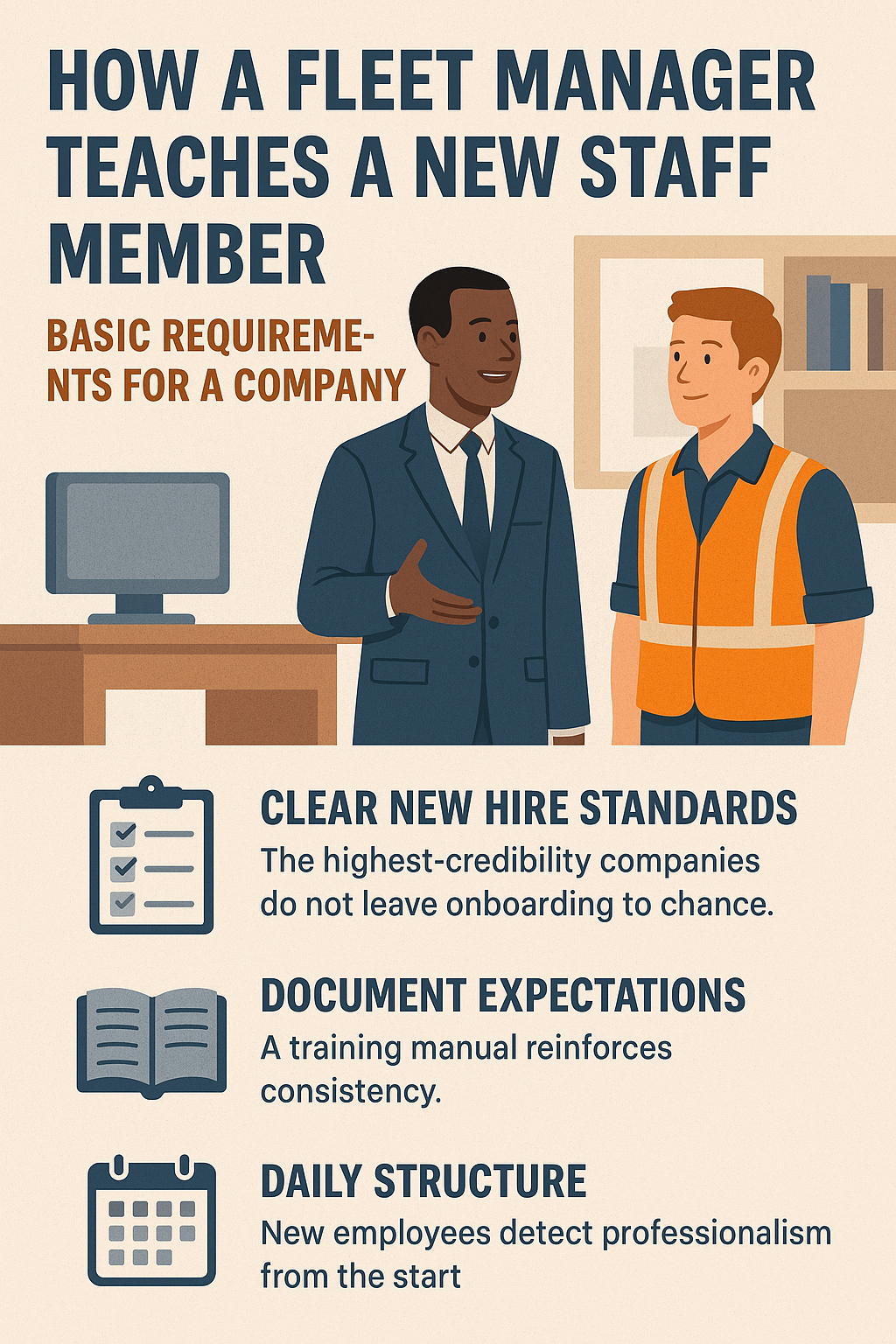
Regardless of whether it deals with freight, utility vehicles, or service units, all fleet operations depend on how well they train their team. Whenever a new member brings into the team, the fleet manager has the task to implement the company policy from the book to the real world. The manager’s training process hardly only starts after orientation; it is the first evaluation of how a company treats safety, performance, and long-term growth.
The companies boasting the highest credibility have a unique trait: they do not leave onboarding to chance. They define clear new hire standards, document expectations, and a training manual that creates a system of consistency. The daily structure is precisely the one that makes a new employee aware from his/her very first day at work that the company is serious about professionalism.
The Significance of Fleet Training for New Hires
A lot of new drivers think that they simply have to pass the recruitment stage and deliver the driver qualification part and other documents for them to start the job. On the contrary, a fleet manager has a lot of more things to do than just point out where the keys are.
An effective fleet training entails the following four aspects at the same time:
Competence – ensuring the new employee learns about the machines, itinerary, and safety protocols.
Habits – transferring values that correspond to fleet safety and company values.
Accountability – making sure that expectations are measurable, not elusive.
Consistency – making certain that all drivers comply with the same performance standards.
Fleet operations that function effectively are the ones which really invest their money on training employees because an accident that could have been prevented or a risky behavior that is being practiced costs far more than the onboarding process ever could.
Research from leading logistics analysts confirms that consistent fleet manager training, clear fleet safety standards, and structured employee training dramatically reduce accident rates and operational losses.
(Source: Inbound Logistics — https://www.inboundlogistics.com/articles/fleet-management-strategies/?utm_source”).
Characteristics of a Company with a Good Training Culture
A new hire should pay attention not only to what is taught but how it is taught. Strong companies rely on a structured system, not improvisation.
1. Clear Training Manual
A top-notch manual contains:
– company standards for safety, communication, and equipment handling
– proper vehicle management procedures
– checklists for pre-trip and post-trip inspections
– escalation steps for incidents, road hazards, or breakdowns
If a company has no written material, that is a warning sign.
What a High-Level Training Manual Usually Includes
| Training Manual Component | Why It Matters |
| Safety standards | Creates clarity and supports a strong training culture |
| Communication procedures | Ensures consistency across the team |
| Vehicle management | Reduces operational risks and reinforces duty expectations |
| Inspection checklists | Prevents safety failures |
| Incident escalation steps | Guides responsible decision-making |
2. Defined Performance Standards
These may include:
– acceptable driving behaviors (speed, spacing, braking habits)
– fuel efficiency expectations
– load securement requirements
– attendance and communication rules
Well-structured organizations do not make the mistake of making new hires guess the rules. It is best if the standards are spelled out right away.
3. A Consistent Driver Training Program
New employees should receive:
– hands-on vehicle safety demonstrations
– instruction on company fleet technology (dash cams, ELDs, telematics)
– detailed route familiarization
– a documented evaluation system
If training is wildly different from day to day, the company is not structured.
4. A Fleet Manager Who Actually Coaches
A real fleet manager checklist consists of:
– skill gap assessment
– early performance monitoring
– corrective feedback
– best practice reinforcement
– certification tracking
The fleet manager who simply passes the binder and says, “Let me know if you have any questions” is not performing true manager training.
How a Fleet Manager Takes a New Hire to the Safety Culture
Fleet safety standards are the spine of the company identity. Companies with a poor safety culture are trying to be smart, on the other hand, companies with a strong culture see safety as currency.
A fleet manager’s approach is usually characterized by:
– Pre-trip and post-trip routines
– Risk-awareness training
– Vehicle-specific orientation
– Emergency procedures
Safety Culture Elements a New Hire Should Expect
| Safety Element | What It Shows About the Company |
| Pre-/post-trip inspections | Indicates consistent safety expectations |
| Risk-awareness training | Shows commitment to proactive training |
| Emergency protocols | Reflects operational stability |
| Vehicle-specific onboarding | Demonstrates thorough preparation |
In What Way Should a Company Integrate New Hires into Fleet Operations
A new employee orientation design that is right does not drown the recruit in too much information. Instead, it is progressive in steps:
Step 1 — Guided Observation
The new employee takes a ride or trains under supervision. The goal is to learn the company’s expectations without pressure.
Step 2 — Guided Practice
The fleet manager guides early driving, offering real-time feedback and reinforcing essential skill mastery.
Step 3 — Independent Evaluation
Only after meeting training standards does the new hire operate alone—ideally with performance reviews during the first weeks.
Step 4 — Measured Integration
The recruit is monitored through telematics, check-ins, and fleet manager notes to ensure consistency.
Companies that do not follow these steps are not serious about safety.
What Novice Drivers Should Look Out for in a Company
Here are characteristics that point to a solid operating structure:
– The company explains rules instead of just assuming you’ll learn them on the job.
– The fleet manager is present, engaged, and accessible.
– Training is systematic, not random.
– Policies match real-world practices—not “paper rules” no one follows.
– Safety outweighs delivery times or productivity shortcuts.
– New hire standards are the same for all employees, not selectively enforced.
These details show whether a company is people-centered or is just putting anybody behind the wheel.
Main Practices that a Good Fleet Manager Will Instill from the Start
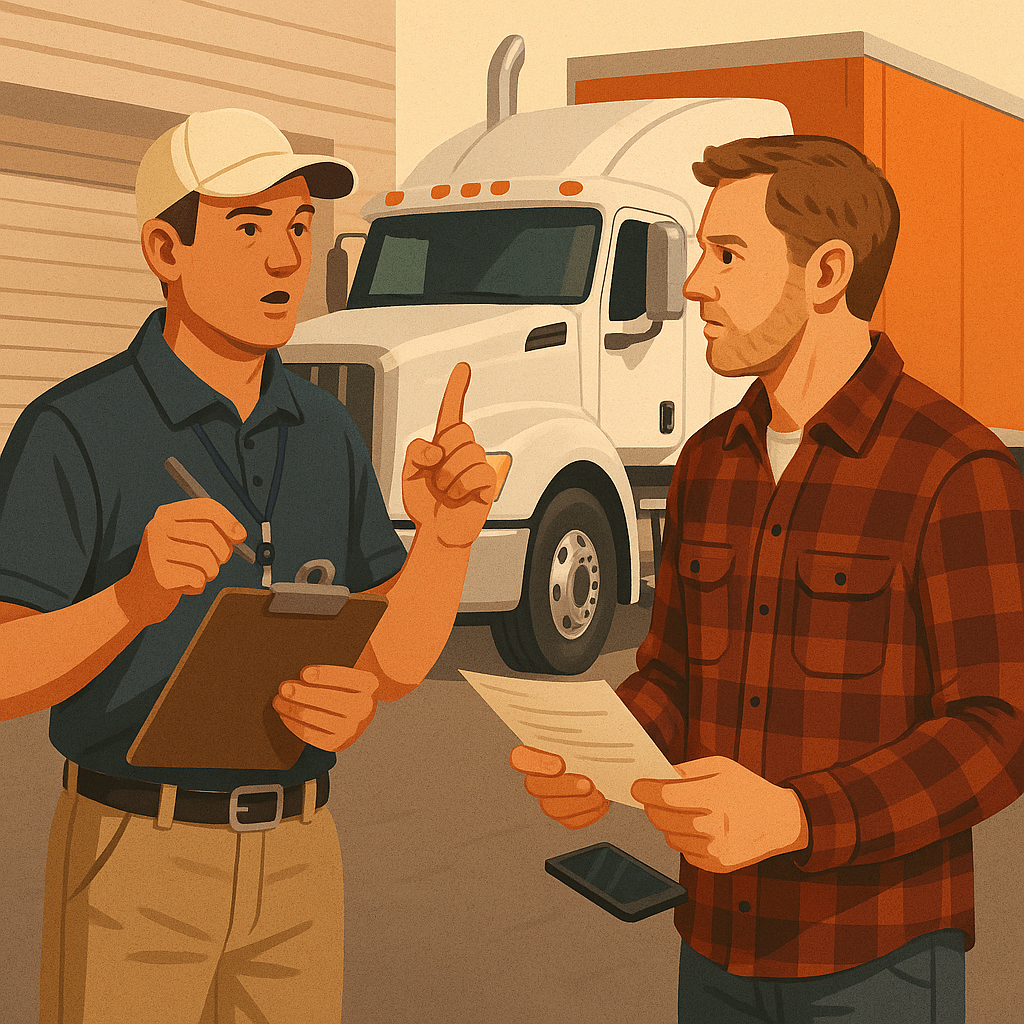
– comply with all items in the fleet checklist
– keep the dispatch and leadership informed on a constant basis
– immediately report any vehicle defects
– be familiar with hours-of-service constraints and legal obligations
– write all incidents properly
– make notes about equipment and schedules that can be respected
– use best practices in their sector, not shortcuts.
These basics diminish problems long term and lay down the foundation for a professional ethos.
Characteristics of Training in a Well-Designed, Strong Company
These include:
– a structure instead of chaos
– accountability instead of ambiguity
– mentorship instead of isolation
– the realization of the company’s intentions through real policies
– necessary resources and tools instead of imitated solutions provided
Successful companies commit to not just their bottom line but to their people.
Companies with weaknesses will ride on employees because they don’t see them sticking around.
The Conclusion: The Training is the Company Behind It
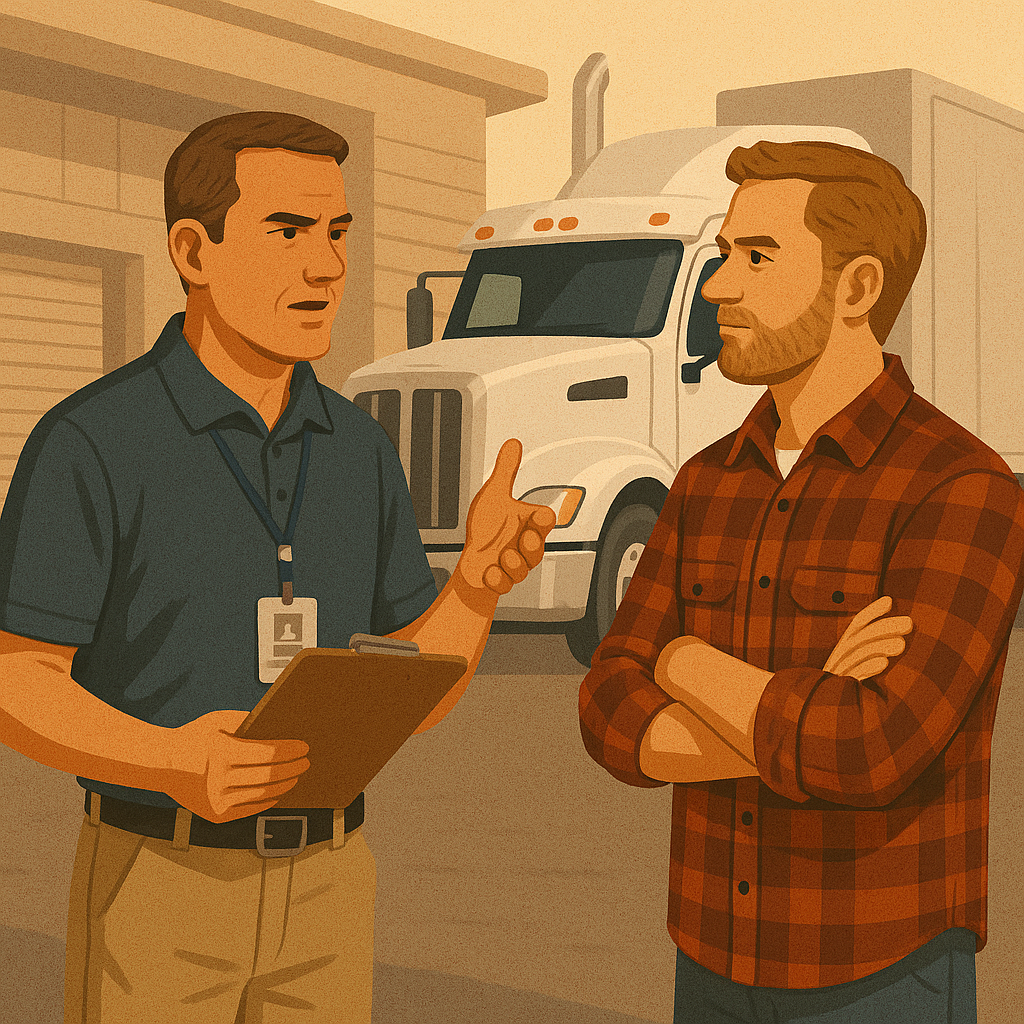
A fleet manager’s training system says more about a company than any banner or webpage can tell. The explicit, well-documented, and systematic training is what makes the fleet manager’s duties uphold what is needed by the leadership who is committed to excellence. On the contrary, the cluttered, fast-paced, or ambiguous training is usually associated with unstable underlying fleet operations.
For a beginner, the first few even of onboarding show which way employer would go: to empower or set one up for the unintended mistakes. The good company standards create self-confident drivers. A strong driver training program creates a successful career out of that.
Besides, the best fleet managers acknowledge the fact that training is not a standalone function; it is an ongoing process that keeps people safe, operations stable, and the fleet moving ahead.
FAQ — Common Questions New Hires Ask About Fleet Manager Training
1. What should I expect during fleet manager training on my first week?
On that week, most firms focus on the structured fleet manager training, which is the introduction to the rules, expectations, and daily workflow. Expect driving with supervision, inspections will be guided, device setup will be basic, and discussions regarding the practical operational habits of the company will be included. A good training program will never just throw you in the wild without a comprehensive outline of the training process.
2. How do I know if a company provides real company fleet training or just a quick orientation?
A reliable employer will offer you the documented company fleet training instead of just giving you verbal instructions. Search for written safety procedures, scheduled practice sessions, a standardized onboarding route, and consistent evaluations. If the whole thing feels like an improvised act, that is a sign that there is little to no structure at the company.
3. Why do fleet safety standards matter so much for new hires?
Fleet safety standards are made to keep costs low, lessen downtime, and protect flux drivers and assets. A good company will show you how to follow inspection routines, properly secure loads, manage speed, handle weather risks, and report defects. Not adhering to the standards puts the company at risk even before you get the chance to start working.
4. What are the most important fleet manager duties during my training period?
The main fleet manager tasks are to check your early driving habits, find any gaps in your technique, oversee the communication discipline, clarify company expectations, and help you to learn and implement the correct procedures. The real fleet manager does not only take care of the trucks; he also brings up new talents.
5. How do fleet managers decide if I’m ready to operate independently?
They will figure this out through a variety of factors, namely watching how you perform, the quality of your route assessment, and inspection, and your ability to follow policy without reminders. The aim is to ensure that the training of the employee is effectively grasped and the employee can meet the required performance and safety standards independently.
6. What signs show a healthy hiring process in a fleet company?
An efficient hiring process should introduce you to the clear communication, transparent requirements, structured onboarding, and expect you to follow the training formally before assuming the full responsibility. Companies that are sloppy in hiring or who skip training steps are the ones with high turnover rates and poor safety scores usually.
7. How long does proper employee training usually last in a fleet operation?
High-quality employee training almost never concludes in a week. Most of the time, it entails driving under supervision, evaluation periods, check-ins, and the ongoing support you receive throughout your first months. Good companies do not see training as a checkbox but as a long-term process.
8. What should I do if training feels inconsistent or unclear?
The first rule is to ask questions during the training period. A strong organization that values clarity will address any inconsistencies. If the management ignores your concerns, hurries your onboarding, or is unable to clarify policies, this may be a sign of more profound issues with their company fleet training structure.
9. Are fleet manager training programs the same in every company?
Not necessarily — there is a significant variance in the fleet manager training programs. Some companies work within a stern and established system while others rely on demodernized, unstructured bonds. The difference generally indicates the firm’s professionalism and emphasis on long-term safety.
10. How can I tell if a company genuinely cares about training and safety?
Pursue written procedures, continuous coaching, transparent standards, proactive communication, and leadership that rules the same as the employees do. When the management covers fleet safety it has a positive effect on all that is happening in the workplace.