
In my initial journey as a new CDL holder, I was under the impression that my entry into the trucking industry was now much easier than before. I had completed my exam successfully, got the legal document, steered my way through the range exercises, and learned to change gears without having to grind the gears. All of it felt like I had won a battle. Yet, in reality, that was just the beginning of the road for a new truck driver starting an entry-level trucking path.
Recommended video for new CDL holders thinking about OTR:
Should New CDL Drivers Go OTR? – Everything You Need to Know
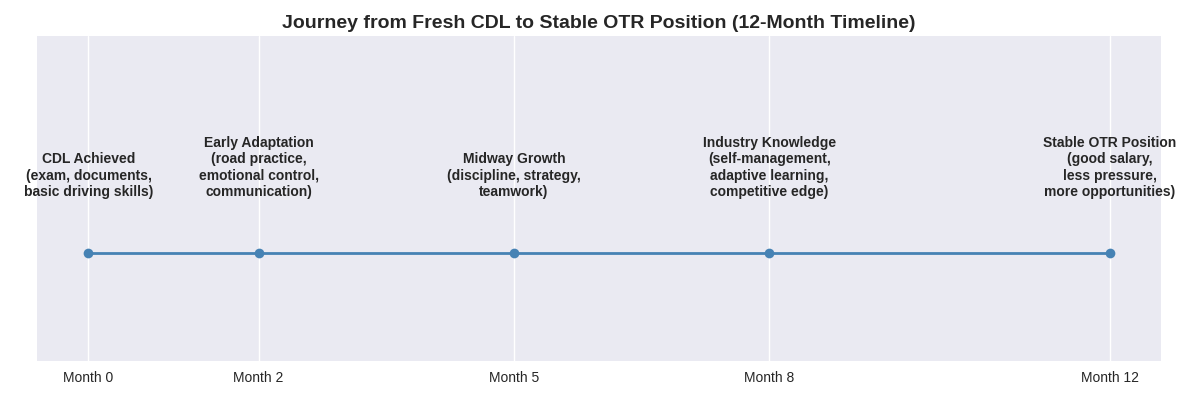
The process of upgrading from a novice licensed CDL driver to getting my own safe OTR spot is more than just learning to drive a truck. It’s a process that includes spiritual discipline, communication, emotional control, and strategy as well as self-management, adaptive learning and industry knowledge which surpasses competitors. In other words, it’s a full driver transition from fresh CDL to OTR and the foundation of a stable trucking career.
Herein is the narrative and the arranged itinerary illustrating how I jumped between being a total novice to an assured, stable OTR driver in the time of just one year. You will find here none of the theories taught in class; instead, it is the real path that a trucker who starts from the bottom encounters before he or she finally can build a successful and long-lasting OTR trucking career with a good salary, less pressure, and more opportunities in the field. This is my personal truck driving journey and practical guide on how to get OTR job and turn the first year OTR into real new driver success.
Month 1: My Shocking Discovery that a CDL Sighted Alone Is Not Enough
The first month after I obtained my commercial driver’s license literally felt like being at the top of a stormy yacht without even having a map. I am all praises for the CDL examiners, but I was bamboozled by the realization that so many training programs do not prepare newbie drivers as per the industry ground reality. For anyone in entry-level trucking, this can be a brutal wake-up call.
Driving schools for trucks usually teach you how to:
- pass the test
- avoid running cones
- practice basic safety procedures
They will not tell you how to:
- anticipate traffic maneuvers
- understand fatigue’s influence on decision-making
- realize how dispatch works under presser
- see different angles of where one mistake makes new mistakes shoot
- manage time, emotions, expectations, and unexpected delays
Throughout my training, I was overwhelmed. Each day brought me a new “first”: first solo trip, first night driving, first breakdown, first wrong turn, first rude shipper, first snowstorm. It was my real introduction to truck driving experience, beyond any classroom examples.
But amid the chaos came my first big lesson:
Having a CDL allows you to get hired — but being consistent makes you a sought-after employee.
OTR companies look for stable drivers, and that stability comes only with experience, a set routine, and mental discipline. That’s the real key to getting stable OTR job opportunities instead of bouncing between carriers.
Month 2–3: Learning the Road and Learning Myself
In the second month, I realized the contrast between “driving the truck” and “being a truck driver.”
The easy part was steeling the truck.
The hard part was knowing about everything else.
I began to spot some regularities:
- Some areas always have late shippers.
- Some receivers want to see you 30 minutes ahead of time, not when you arrive.
- Some highways are clogged every Saturday afternoon.
- Routes through the mountains require different timing than flat ones.
- Parking becomes dramatically less available after 7 p.m.
With every element of the pattern that I learned, each day got less stressing.
I also conducted a log, which was my personal discovery notebook rather than a DOT logbook. I was putting records of the following:
- load/unload average times per location
- gas stations with turns too tight
- the rest areas that normally fill early
- customer dock shapes
- the way weather interfered with ETA
With time, this notebook became an incredibly powerful tool for me. Dispatchers caught sight of the fact that I was not making the same mistakes anymore and I was advocating for myself unlike most rookie truckers. It made me feel like I was finally becoming an OTR driver, not just a name on the board.
Rookies who can’t get it through their thick skulls and advance are all but struggling while fresh drivers aren’t.
The top CDL drivers see it simply:
It’s about education on every mile you drive, especially in your first year OTR.
Month 4: Fixing Communication and Gaining Trust
In month 4, I had a sufficient number of rough experiences to arrive at one universal truth:
your relationship with dispatch accounts for 50% of the success of your career.
In the early stages of my driving experience, my communication was mostly like that of a rookie — reactive and emotional.
I would often have dialogues like:
- “I’m on the roads in a jam. I’m late now.”
- And what’s worse:
- “I have no idea what to do.”
Dispatcher’s ears start to itch when they hear such phrases being repeated every time a day. Pro-active, structured communication like:
“Traffic slowdown on I-80; updated ETA 16:40. Will maintain safe pace and keep you posted if conditions change.” is what actually earns trust.
The relationship prevails in the same circumstances only that now I am the leader instead of being lost.
This month I discovered that true professionalism in trucking is not the absence of errors, it’s about being calm, clear, and predictable. Good communication is what separates a new truck driver who struggles from one who is on a serious path from fresh CDL to OTR stability.
Month 5: Facing Real Mistakes and Growing from Them
Every noob truck driver crashes into a wall in Month 5. You are self-sure enough to chill, but you are not sufficient experienced to dodge new blunders. I did my share of typical rookie blunders:
- taking a different route that “GPS knows better”
- forgetting to scale a suspiciously heavy load
- charging into docks instead of preliminarily walking the path
- assuming a receiver would take me a little early (they didn’t)
Every error cost some time. Some costed me a good night sleep.
But every error was an experience that no CDL training program could ever teach me. Each mistake became part of my truck driving experience and part of my driver transition from trainee to working professional.
The most crucial realization was drivers at dispatch simply don’t expect newbies to be perfect but they want them to be upfront and to expedite fixes on mistakes.
My changing from blaming others to accepting responsibility was the point of the shift from being treated as a novice to being treated as a professional. This shift was essential in my OTR job search inside the company — because planners and dispatchers started to see me as someone ready for more responsibility and more miles.
Month 6–7: The Foundation of Stable OTR Building Consistency
In the second half of my first year, things began to settle down. Not because the job got any easier, but because my actions became predictable.
The bottom line was I soon found that I had:
- an idea of how long I could drive before fatigue would hit me
- knowledge of where it was best to park at different times of the day
- the ability to read the flow of traffic in new cities
- the knowledge of when to take 30-minute breaks
- the talent of communicating problems in a precise way
Above everything, I developed a rhythm.
Rhythm is the starting point of stability in OTR trucking.
The rhythm in every aspect — trip planning, sleep cycles, fuel timing, communication style — is what has made things so easy for me. So much so, that the dispatch has started to deliver the pattern they know I am not going to disappear, panic or create chaos.
My mileage increased dramatically from this point on, and for the first time I felt like I was truly getting stable OTR job assignments instead of random leftovers. This was the turning point where new driver success stopped being a dream and started to look like a system.
Month 8: Understanding Freight Strategy and Seasonal Behavior
Month 8 was the time when I got acquainted with the business of trucking — a notion that most inexperienced drivers neglect until it is too late.

The things I learned about the freight lanes that I used to drive included:
- freight lanes cry for attention
- lanes are reliable during the snow season
- they are slow after holidays
- are packed, but simple
- light, but time sensitive
- high-paying but cold
- low-paying though stable
This knowledge has allowed me to chime my personal goals with the company logistics. Following it, I would no longer be stuck in the low-freight areas because I learned to ask for the lines that I knew guaranteed a longer level of OTR. In practice, this is how you quietly build a stable trucking career without hopping from carrier to carrier.
I moved from simply “getting loads” to more of a critical approach, such as “choosing smarter loads.”
This was indeed the month of my breakthrough in becoming an OTR driver who understands freight, not just follows orders.
Month 9–10: Relationship Capital Becomes Career Capital
Many new drivers underdevelop the significance of relationships in trucking. Your informal network, both inside and outside the company, plays a huge part in stabilizing your job as an OTR driver.
By Month 10, I already had a strong relationship with:
- dispatchers
- planners
- safety coordinators
- mechanics
- overnight dispatch
What was the point?
Because drivers who are recognized to be trusted receive:
- priority loads
- longer miles
- better time for being at home
- fewer deadhead routes
- more flexible routing
The formula is rather simple:
If you can ease their workload, they will actually improve your OTR life.
At this stage of my truck driving journey, I saw how relationship capital was directly converting into miles, pay and choice of lanes. That’s something no one explains to you during commercial driver’s license training — but it’s a core part of how to get OTR job stability.
Skills That Grew Month by Month
| Skill | Month 1 | Month 6 | Month 12 |
| Route Planning | Basic | Consistent, solid | Highly optimized |
| Communication | Emotional | Professional | Strategic and proactive |
| Time Management | Poor | Improving | Strong |
| Confidence | Low | Medium | High |
| Freight Understanding | None | Developing | Advanced |
| OTR Stability | Nonexistent | Improving | Achieved |
Month 11: A Professional, Not Only a CDL Holder
In Month 11, I started feeling a click. I no longer simply did the job; I comprehended it all.
I started to think as an experienced driver would:
“If I handle the load with care, there’s a good chance I will fall into a freight-rich area on my next one.”
“If I take this particular break now, I can avoid parking problems later.”
“Such a customer always delays the arrival; I should bring food and a plan to rest.”
This month I also discovered how imperative self-management skills are in OTR:
- drinking enough water
- sleeping with discipline
- dealing with stress
Pacing means less speedy miles not sprinting.
Being a professional is not about controlling the number of miles — it’s about mastering the routine. That’s when you really feel the transition from fresh CDL to OTR veteran in your own mind.
Month 12: Achieving Stability and Planning the Future
At long last, in Month 12, I truly felt the change. What appeared to be too daunting in me so long ago was now a piece of cake. The anxiety, confusion, and the fear of messing up were all gone.
Example of what a more stable solo OTR routine can look like in practice:
A Day In the Life of a SOLO OTR Truck Driver
In their place, I had:
- stable checks
- acceptable schedules
- laying routes which are long-haul and consistent
- departure recognition from dispatch
- disarriage with fear of a load in bad weather
- an actual OTR trucking career, not just a temporary job
Switching from a fresh CDL driver to a stable OTR professional was not about one big leap ahead but rather about hundreds of tiny steps that I took over a year. It was the result of deliberate OTR job search decisions inside the company, steady performance, and daily learning.
What Factors OTR Stability Really Involved
| Factor | Importance | Why It Matters |
| Communication | 10/10 | It’s the trust factor and freight priority determinant |
| Reliability | 9/10 | Companies prefer drivers who are predictable |
| Trip Planning | 9/10 | It aids in timely delivery and diminishes stress |
| Fatigue Management | 8/10 | It ensures your safety and consistency in performance |
| Customer Skills | 7/10 | It enhances company esteem |
| Flexibility | 8/10 | Dispatch can give out better lanes |
| Self-Discipline | 10/10 | Which is a prerequisite for OTR success in the long term |
The Secret that is Not Real Time but Approach
Many new drivers have a misapprehension that being on the road for a year is enough for stability to just happen by itself. That is very false.
There are separate driver issues who still run the unstable routine for many years because they never adapt.
Stability is:
- being proactive instead of acting in react
- being clear instead of being emotional in communication
- learning from mistakes instead of doing them again
- making relations instead of tearing the network
- taking trucking seriously as a job, and not just for a small paycheck
If you take such steps, you won’t need 12 months at all, but instead, start feeling settled in about 7–9 months.
And if you ignore these things, even 3 years may not be enough.
That is how I went from fresh CDL to OTR stability in one year — and how any new truck driver can turn their first year OTR into the start of a truly stable trucking career and long-term new driver success.