
The first year of a rookie truck driver, despite the challenges on the road, is still a collection of experiences. The principle lesson for each truck driver is one year learning many new things; however, nothing is more strange to comprehend in the beginning than how the income is actually calculated by you. While trucking companies focus on the cents per mile remuneration, the sign-on bonuses, and the potential monthly earnings, the truth is that the starting driver has to spend some time to link all these elements and picture them in one single, understandable financial way. The pay for rookie truckers is far from the typical fixed salaries; that is, other than the constant pay, which is affected by factors like distance, mile, and delay time, each carrier has its own bonuses. It becomes the first moment a driver truly learns what rookie truck driver pay and early truck driver compensation really look like in practice.
Now the new drivers learn to assess their earning before they have completed the first phase of the CDL apprenticeship. They know the things that affect their mileage checks, the things that are counted as paid downtime, immaterial aspects like performance pay, as well as the big difference between the average and the first-year salary provided in the trucking industry. Wages for neophytes reflect both the hard work done and the market and company conditions plus driver performance related to regularity. Tunnel vision on the above factors changes the confusion to control and from control to reasonable financial management, especially when understanding rookie driver wages and how trucking company pay systems actually work.
This article dissects income from rookie truckers into simple parts and accompanies with templates that give monthly and annual salary earning estimates. By the end of the reading a fresher will be able to account for every cent of his truck driving income as well as work out a predictable model of his income even in uncertain conditions. That model becomes essential when estimating truck driver income during the unstable months of training.
The Base of Rookie Salary: Pay Per Mile
What is the Average Pay Per Mile for Trucking? – CDL Driving Academy
Apart from the hourly mode that is found in some other sectors, trucking relies on the pay-per-mile way of remuneration. This is the main form of truck driver salary in the majority of transportation companies, particularly in the very first year. This system defines most rookie driver wages and is the core of first-year pay calculations.

In general, a rookie can make 40–55 cents per mile but the exact rate depends on the geographical area, company size, type of cargo, and whether the fleet does refrigerated, dry van, or line-haul work. While the salaries of seasoned drivers rise every year, the rookies have to earn their share by keeping the miles and quality performance on balance. This is why pay per mile becomes the driver’s first true financial discipline.
One of the misconceptions that rookies have is that “more miles equals more money” in the linear case. The truth is that they might experience ruinous weeks like the weather that could delay rainy freight, breakdowns, and shortage of drivers. The principal pay rates for truck drivers, young drivers version included, are highly variable depending on the on-ground scenarios. It takes time to understand how truck driver income shifts from week to week.
Yet, miles are a straightforward, if not simplest, way for one to estimable for the basic possible figure, forming the foundation of any monthly base rate estimate used in trucking company pay structures.
An Easy Example: Rookie Mileage Payment Estimation
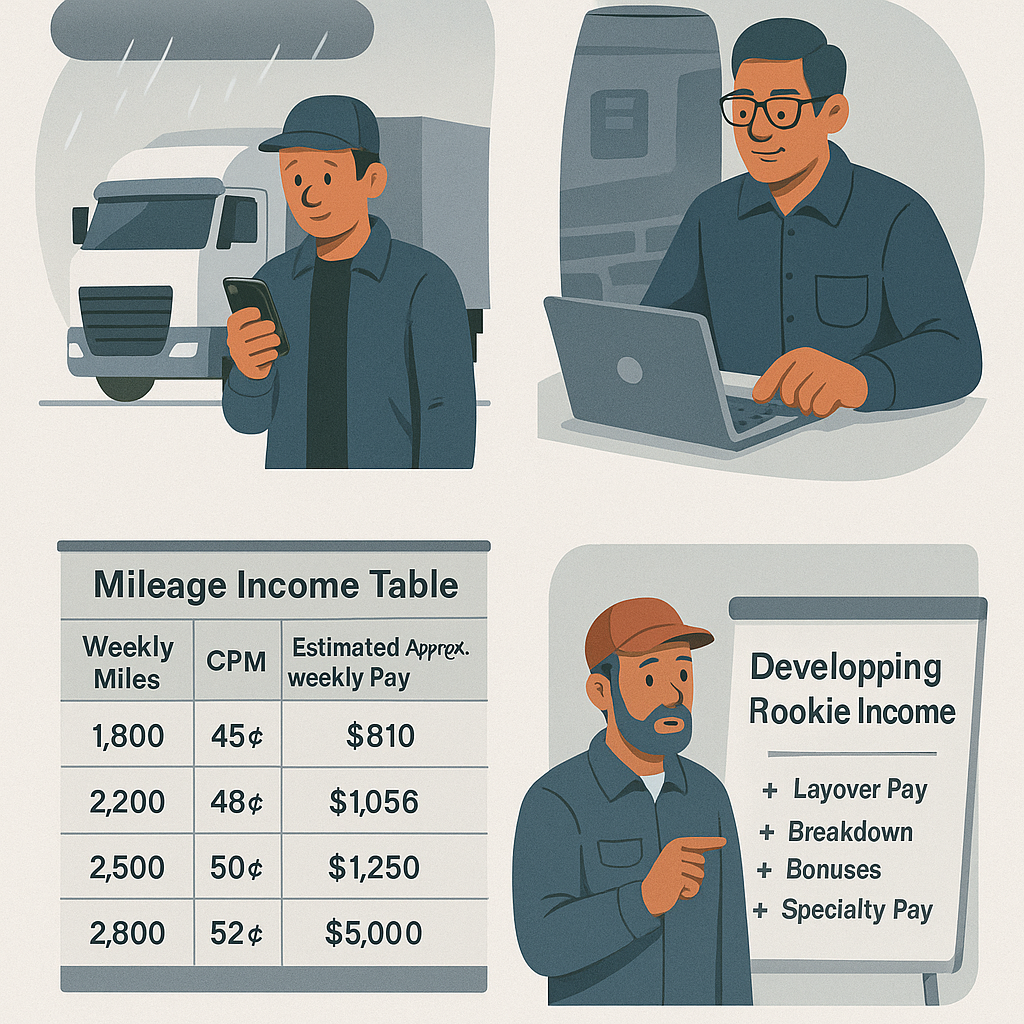
Below is a table with miles driven and CPM (cents per mile) along with integrated first-year driver salary per month. All figures are market-based and provide rookies with a realistic idea of what to expect.
Mileage Income Table — Rookie Driver Pay
| Weekly Miles | CPM Rate | Estimated Weekly Pay | Approx. Monthly Pay |
| 1,800 | 45¢ | $810 | ~$3,240 |
| 2,200 | 48¢ | $1,056 | ~$4,224 |
| 2,500 | 50¢ | $1,250 | ~$5,000 |
| 2,800 | 52¢ | $1,456 | ~$5,824 |
As for starters, the miles per week during the CDL apprenticeship, which are usually of the range 1,800 to 2,300, are common although, some of them could be higher or lower depending on freight conditions. Mileage calculations are the primary reference for monthly income assessments and influence nearly every truck driver compensation forecast.
This is the first and fundamental understanding before adding bonuses, pay for downtime or other types of compensation e.g., line haul pay.

Prolonged Time: the Most Misunderstood Element of First-Year Salary
A rookie often asks: “What if I am paid per mile, and then I don’t move?”
This is where it comes to the real problem of the rookie. Consequently, repaying downtime is so critical. Downtime pay can arise out of these situations:
- Detention: Long waits at shippers or receivers
- Layover: Freight delays leaving the driver stuck overnight
- Breakdowns: Mechanical problems that need a repair
- Weather shutdowns
- Dispatch gaps
A few companies pay different rates for detention and layover:
- Detention: $15–$30 per hour after a grace period
- Layover: $75–$150 per 24 hours
- Breakdown pay: A flat daily rate or hourly compensation
Downtime payments, on the other hand, are your shield against permanent damage. They might not fully replace your mileage income, but they will definitely cut off possible huge losses at the end of the day. Eventually, they make it predictable for you to work in a field where not every step can be made at will — a key survival skill in rookie truck driver pay management.
Bonus Structures Found in the Rookie Pay
Despite being in the first year, many carriers implement bonuses and as a result, the newbie’s earnings significantly increase. Bonus structures according to trucking companies have become an effective way of recruiting and keeping good drivers and are a major supplement to truck driver compensation systems. These structures often include targeted driver bonuses that reward safe, consistent performance over time.
Typical examples of the bonus are:
- Performance pay: Fuel efficiency, Safe driving metrics, On-time delivery
- Sign-on bonuses: Often paid in installments not upfront
- Referral bonuses: Allowances for bringing new drivers into the fleet
- Safety bonuses: For accident-free quarters
- Production bonuses: When mileage exceeds a threshold
A rookie should really take time to comprehend that bonuses are not a given but they are a sure thing if you assure your performance, and keep clean logs. But it is quite normal that these bonuses will be added about $2,000–$6,000 per year to your income, and sometimes even more, depending on the company’s policies. For many, this forms the most profitable part of their first-year pay beyond mileage.
Template for Calculating Bonus Income
Below is a table that indicates what a rookie might realistically expect from bonuses that they would earn in their first year:
| Bonus Type | Typical Range | Rookie Expectation |
| Safety Bonus | $250–$1,000 quarterly | Higher with clean record |
| Performance Pay | +1–4 CPM | Grows with consistency |
| Sign-On Bonus | $1,000–$5,000 total | Paid gradually |
| Referral Bonuses | $500–$1,500 per hire | Easier once a network is built |
Rookie drivers should track their bonuses each month and use what they learn to make good predictions about what they will earn and what types of behavior lead to long-term professionalism. For some drivers, referral bonuses evolve into a reliable, relationship-based income stream as their network in the fleet grows.
Line Haul Pay and Additional Compensation Changes
Some trucking companies adopt hybrid compensation structures especially in freight networks such as LTL (less-than-truckload) operations. Line haul pay offers rate per piece or route regardless of deliveries made.
In LTL & special freight:
- A rookie driver can earn a fixed salary per run regardless of the waiting period
- Terminal-to-terminal routes increase consistency
- .Pay can be a combination of mileage and hourly rates.
This is a format that attracts rookies who want an even life without pinning their earnings entirely on their miles.
Also, seasonal influx, fuel bonuses, and holiday pay may add variation to the total income package. The differences are the basics of the rookie being a strategist, especially in navigating trucking company pay fluctuations.
Developing a Revised Rookie Income Template
The formula below is one of the most neat and clear total income calculation amounts for a first-year trucker. It concerns total income for a trucker instead of a trucker’s only mileage and applies directly to forecasting rookie driver wages.
First Year Truck Driver Income Calculation Formula
Total Monthly Pay =
(Monthly Miles × CPM)
- (Detention Pay + Layover Pay + Breakdown Pay)
- (Monthly Share of Bonuses)
- (Any Line Haul or Specialty Pay)
The structure allows a rookie to apply it in their own way to create their own spreadsheet which they can use for tracking their income weekly and monthly. This becomes the foundation for evaluating average industry wage and long-term earning potential.
Example: First Year Driver Earns This In A Month
A rookie drives a total of 9,000 miles in a month on a rate of CPM 48:
- Base mileage: $4,320
- Detention payment: $180
- Layover reimbursement: $150
- Safety bonus (monthly breakdown of quarterly bonus): $150
- Fuel efficiency bonus: $60
Total Estimated Monthly Earnings: $4,860
In a booming freight market, a rookie driver may earn more than $5,000–$6,000. Conversely, during the low seasons, there may be decreased pay. This system of calculations helps the drivers to have a clear and reasonable estimation of the pay — crucial for predicting first-year pay expectations.
Expectations: First-Year Salary vs Seasoned Driver Salary
A rookie salary is a stepping stone on the long run earn. Generally, the first-year pay stands at $45,000–$65,000 depending on how many miles driven are in accordance with the company policy.
The progress for experienced drivers, especially the ones that have clean records and strong performance, is as follows:
- Higher CPM
- Specific routes
- Specialized freight (tanker, flatbed, heavy haul)
- Owner-operator or self-employed driver paths
Apart from that, some self-employed drivers earn excellent sums, yet the expenses including fuel, insurance, maintenance, and equipment alter the income structure entirely. Therefore, it is advised that newbies do not regard themselves at the same level of selected traders or those who work independently but instead they should concentrate on their own benefits that they can gain through each mile and hour of work. This understanding is key when comparing rookie truck driver pay to experienced driver pay.
The Road to Earnings: Making Unsure Factors Become Sure
The main concern for the rookies is usually the sense of income being too random. But transferring to certain income levels starts from comprehending the whole game. So, when a rookie understands the role of miles, downtime, bonuses and performance in making the profit come to be, the rookie will know how to predict earnings.
This, in turn, will create a strong belief, lower down financial worries and enhance long-term planning from budgeting the fuel stops to estimating their annual tax obligations — an essential part of managing truck driver compensation long-term.
Getting a grip on rookie truck driver salary issues is made easy once the driver comprehends how to study each factor. Just by means of templates like those found in this article, the newcomer can learn how to practically forecast their financial standing from which they will transform from merely guessing their earnings to computing them in forms that are free from any doubts.
FAQ
- Why do rookie drivers earn less than experienced drivers?
Experience leads to higher CPM, better load selection, and more trust from dispatch. Rookies are still learning consistency and safety performance. - Are bonuses really achievable in the first year?
Yes — especially safety and performance bonuses. Sign-on bonuses are common too, though they are typically split into installments. - What affects mileage the most for a new driver?
Weather delays, freight volume, dispatch availability, and your own on-time performance all shape weekly miles. - How much downtime pay should a rookie expect?
It varies, but detention and layover compensation help stabilize income when freight slows or delays occur. - Can rookies choose line haul pay instead of pay per mile?
Some companies offer LTL or dedicated line haul routes, but most rookies start with mileage-based pay. - Do monthly earnings increase quickly in the first year?
Yes. As rookies gain efficiency and trust, they often see their miles — and pay — rise during months 4–12.