
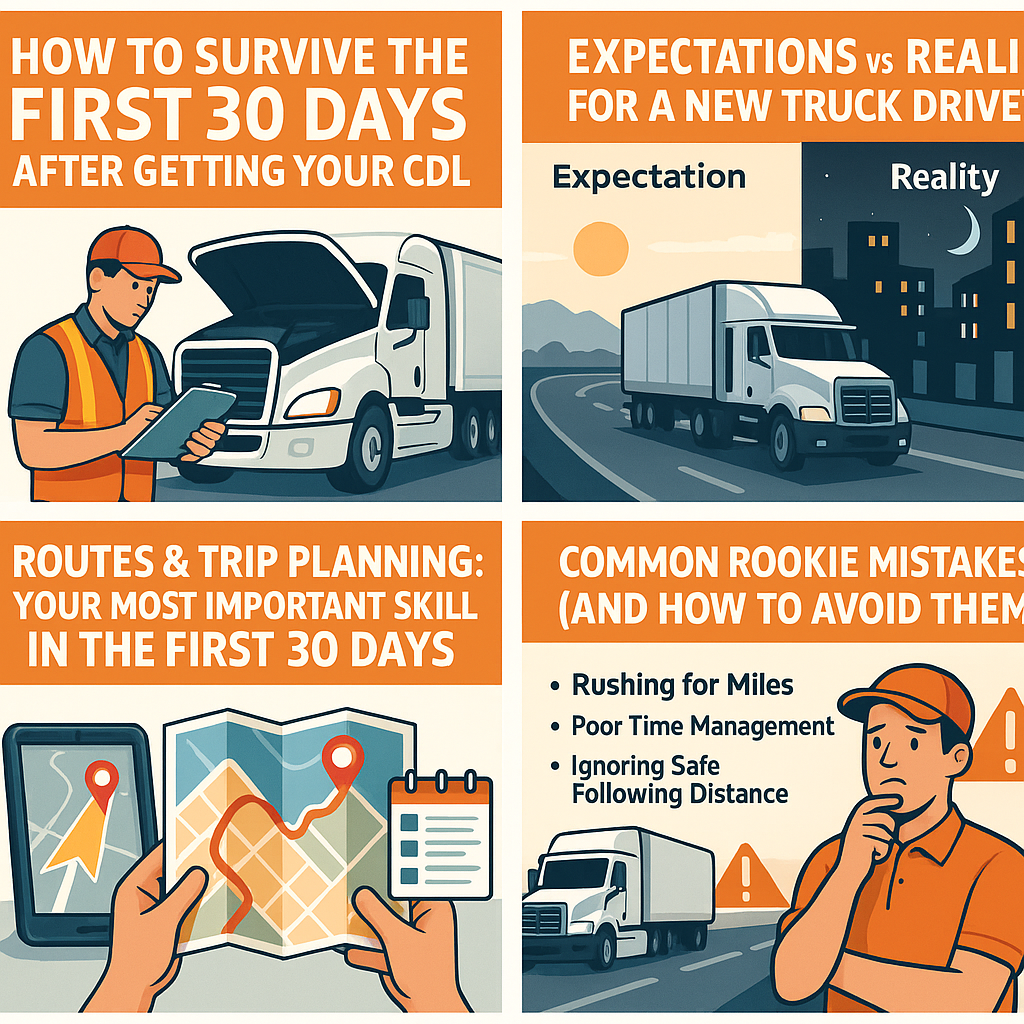
Gaining your CDL is one big thing that can never lose its worth. But with the first 30 days on the road, you are actually on board for the real truck driver career. Everything you learned in truck driving school suddenly becomes real, such as running on tight schedules, unpredictable delays, parking issues, and driving through different weather conditions as well as carrying the responsibility of a commercial vehicle worth over $200,000 in your hands. These early weeks mark the moment every rookie trucker begins translating road training into real practice.
It is common for a new truck driver to feel stressed in those first weeks. The adjustment of the truck size, getting to know the way dispatch works, figuring out your backing maneuvers, and imagining a typical day as a truck driver, which is not that ridiculous, takes time and effort. During this time, many rookie drivers might doubt their capabilities (“Is this the job for me?”) but the fact is that:
The first month is not about achieving perfection, it is solely about instilling the good habits that become your trademark throughout your CDL career. The right driving tips and mindset help you survive this period and build solid career expectations.
This guide outlines the most essential skills, expectations, and ways to cope that every entry-level operator will need to have in order to win and survive the first month on the road.
Why Your Initial 30 Days Matter More Than CDL School
CDL training introduces you to the bare basics: shifting methods, first backing practices, rules of the road, pre-trip procedures, and safety fundamentals. Over and above, the moment you are handed a freight-loaded real truck, the game changes. You are now faced with the following pressures:
- Tight delivery windows
- Heavy traffic
- Long hours
- Unexpected delays
- Fatigue
- Customer instructions
- Real-world truck driver safety decisions
Your first month in the field brings about three major developments:
- Your baseline habits form — positive or negative.
- You experience the real expectations of a trucking company, dispatcher, and clients.
- You face your strengths and weaknesses — backing, route planning, time management, stress handling, etc.
Many rookie truckers quit their trucks in 90 days not because they don’t have the skills but because their hopes and dreams are divergent from the real CDL career reality. When you accept that the first month is an adjustment period, not a performance test, everything becomes easier.
Expectations vs. Reality for a New Truck Driver
Expectation:
You will get immediately the long miles, simple routes, and the most of the time.
Reality:
The very first routes you might operate consist of cities, night shifts, tight docks, unpredictable schedules, and short hauls. That might look a bit much to you.
Expectation:
Mistakes are going to be taken as a sign of your incompetence.
Reality:
Each entry-level driver is bound to make mistakes. What’s more, it is their attitude to mistakes that is of utmost importance — by asking questions, going GOAL (Get Out And Look), and learning something new every day. Even the best drivers once struggled with common mistakes.
Expectation:
You are going to feel like a driver who has been on the road for years by the end of Week 1.
Reality:
Most drivers don’t feel confident until between Month 6 and 12. It primarily comes from experience, not from a CDL card.
Understanding the Rookie Mindset
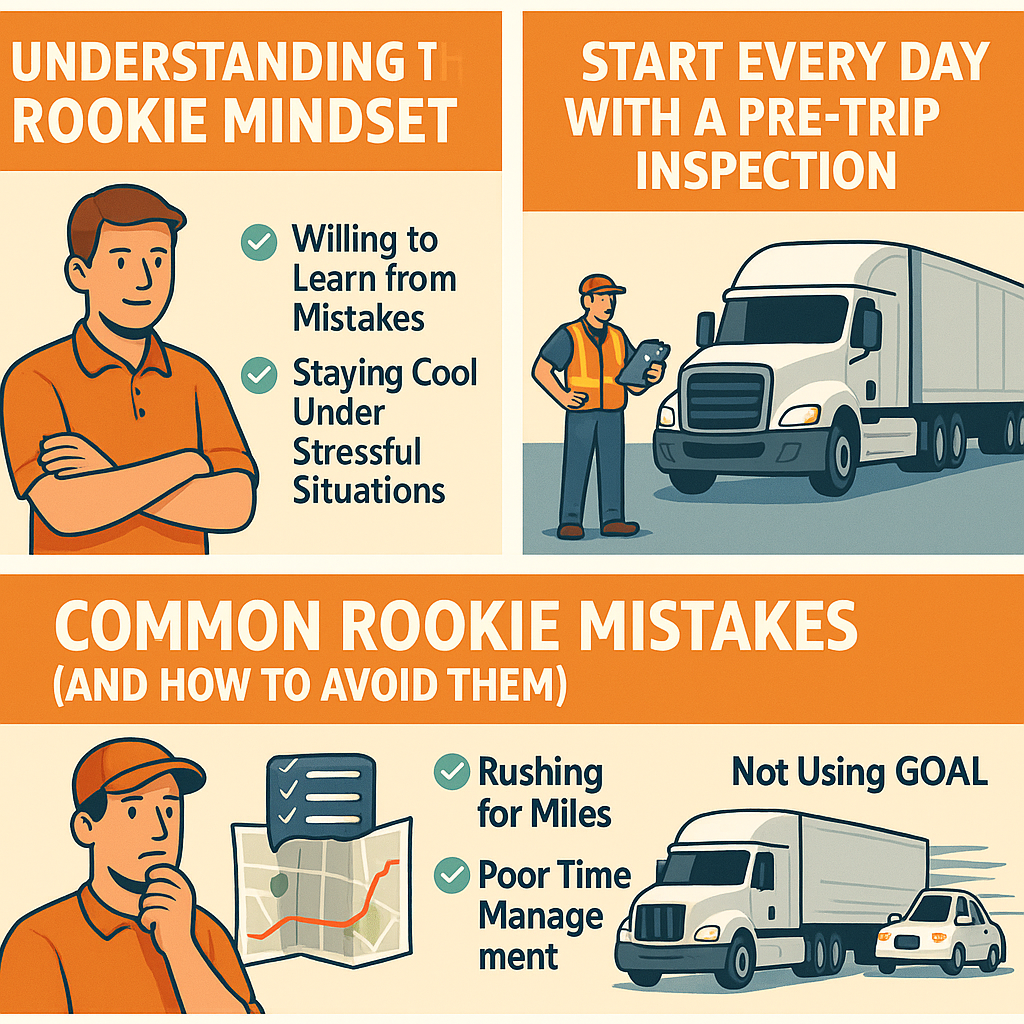
New drivers that are successful exhibit three characteristics:
- They’re willing to learn from mistakes
- Staying cool under stressful situations
- The commitment to constant improvement
In your first 30 days, you are not being weighed on speed or productivity — you are being weighed on safety, communication, and reliability. That is all.
No accidents, no injuries, no violations.
Everything else is progress.
Routes & Trip Planning: Your Most Important Skill in the First 30 Days
A new commercial driver finds out very quickly that trip planning is the primary part of the job among almost everything else. Your GPS will not be of assistance. Google Maps is not made for trucks. Dispatch will give you the endpoint but you are the one to choose the route that is both safe and efficient. This is where learning to plan time becomes crucial.
Below is a tangible pathway for developing reliable trip-planning behavior.
1. Start Every Day With a Pre-Trip Inspection
A complete pre-trip inspection is the base for a safe truck driver. It keeps you legally, mechanically, and financially safe.
Daily Pre-Trip Checklist
| Element | Please Check |
| Lights | Brake lights, turn signals, headlights |
| Tires | Pressure, tread, visible damage |
| Fluids | Oil, coolant, washer fluid |
| Brakes | Air leaks, slack adjusters |
| Coupling system | Kingpin, fifth wheel lock |
| Load securement | Straps, chains, seals |
| Emergency equipment | Triangles, fire extinguisher |
Carrying out a proper pre-trip takes 12 to 15 minutes, and it will stop quite a few of those rookie mistakes.
2. Build a Route Plan — Not Just a GPS Path
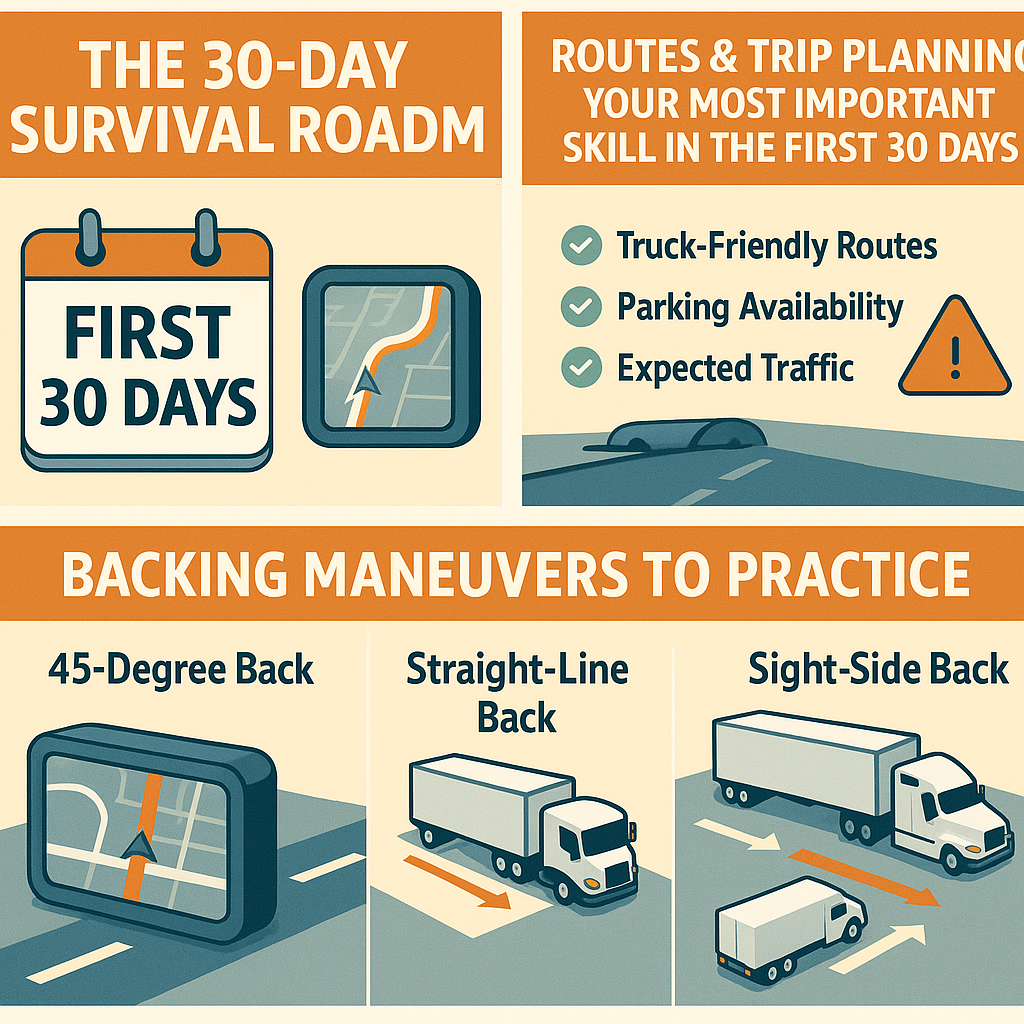
A truck driver never puts all their eggs in one basket. Your route plan is to have:
- Truck-friendly routes
- Fuel stations
- Weigh stations
- Weather patterns
- Terrain
- Parking availability
- Expected traffic
Tools You Should Use Together
| Tool | Purpose |
| Truck GPS | Height/weight restrictions |
| Motor Carrier Road Atlas | Backup routing & truck-legal roads |
| Weather apps + 511 DOT websites | Check storms, wind, road closures |
| Shipper/Receiver instructions | Best entrance, local hazards |
| Satellite view (Google Maps) | Checking dock layout before arrival |
Your goal is to avoid surprises because surprises in trucking cost hours — and sometimes accidents.
3. Plan Time — Especially Parking Time
Parking is the most significant issue for new truck drivers.
A rookie mistake is to assume that you’ll find a free parking lot at 8 to 10 PM. Most of the time, truck stops are full in early evening.
Best practice:
Shut Down Early, or Reserve Spot When Possible.
Parking Maneuvers to Practice:
- 45-degree back
- Straight-line back
- Sight-side back
- Blind-side back (avoid whenever possible)
Developing these parking maneuvers early will save you from stress and damage.
4. Weather, Terrain & Road Conditions
The need to consider is:
- Wind
- Ice and black ice
- Mountain downgrades
- Fog
- Sudden storms
- Flash floods
Weather affects braking, turning, and maintaining a safe following distance. Combine this with proper handling size awareness and you greatly reduce risks.
Common Rookie Mistakes (and How to Avoid Them)
All new truckers repeat the same mistakes in the first 30 days. By avoiding them you can enter the top 10% of entry-level drivers.
Mistake #1: Rushing for Miles Instead of Rushing for Safety
Most new drivers are eager to start earning money but that often leads to:
- Violations
- Unsafe driving
- Bad planning
- Fatigue
- Damaged equipment
Solution:
Chill. Your first 30 days are about establishing safety habits, not about chasing miles. Once habits form, you can maximize earnings safely.
Mistake #2: Not Using GOAL (Get Out And Look)
Turning back is what many new drivers mishandle, and incidents mostly occur.
Correct action:
Get Out And Look — even five times — until you are 100% sure.
Mistake #3: Poor Time Management
New drivers often underestimate:
- Loading/unloading time
- Detention
- Dock delay times
- Finding parking
- Paperwork
- Fueling
- Pre-trip and post-trip inspections
This results in a domino effect that leads to late deliveries, stress, and HOS violations.
Solution:
Track how long each task actually takes. Use that information for more accurate planning.
Mistake #4: Ignoring Safe Following Distance
Rear-end collisions are one of the most common mistakes.
Following the 1 second per 10 feet of vehicle length rule is a good idea — add more in rain or snow.
Mistake #5: Not Asking Questions
Many greenhorns avoid asking:
- How to enter a difficult dock
- Which gate to use
- Where to park
- Whether the load is ready
- For route guidance in tight areas
Silence causes problems. Communication prevents them.
Essential Road Skills to Develop in the First Month
| Essential Skill | Why It Matters | How to Practice |
| Backing | Top source of rookie accidents | Practice at truck stops during daytime |
| Shifting techniques | Reduces wear & improves control | Smooth acceleration, avoid over-revving |
| Safe following distance | Prevents rear-end collisions | Add extra space in bad weather |
| Handling size & turning radius | Prevents trailer swing & curb strikes | Take wide turns, check mirrors often |
| Speed control on downgrades | Crucial in mountains | Use engine brake, lower gear early |
| Trip planning | Saves time, avoids low bridges | GPS + atlas + instructions |
| Time management | Prevents HOS violations | Track daily task durations |
| Situational awareness | Foundation of safety | Scan mirrors every 5–8 seconds |
These essential road skills serve as your foundation for long-term success.
Building Healthy Habits in Your First 30 Days
A career as a truck driver is demanding. Without structure, new drivers burn out quickly.
1. Physical Habits
- Daily stretching
- Walk 10–20 minutes per day
- Hydrate well
- Avoid energy drink overuse
- Keep healthy snacks in the truck
2. Mental Habits
- Mistakes are acceptable during the training
- Listen to podcasts/audiobooks
- Call your family regularly
- Take breaks before stress builds
- Keep a learning journal
3. Financial Habits
- Cook simple meals in the truck
- Track weekly spending
- Avoid impulse gear purchases
- Understand your company’s pay structure
The 30-Day Survival Roadmap
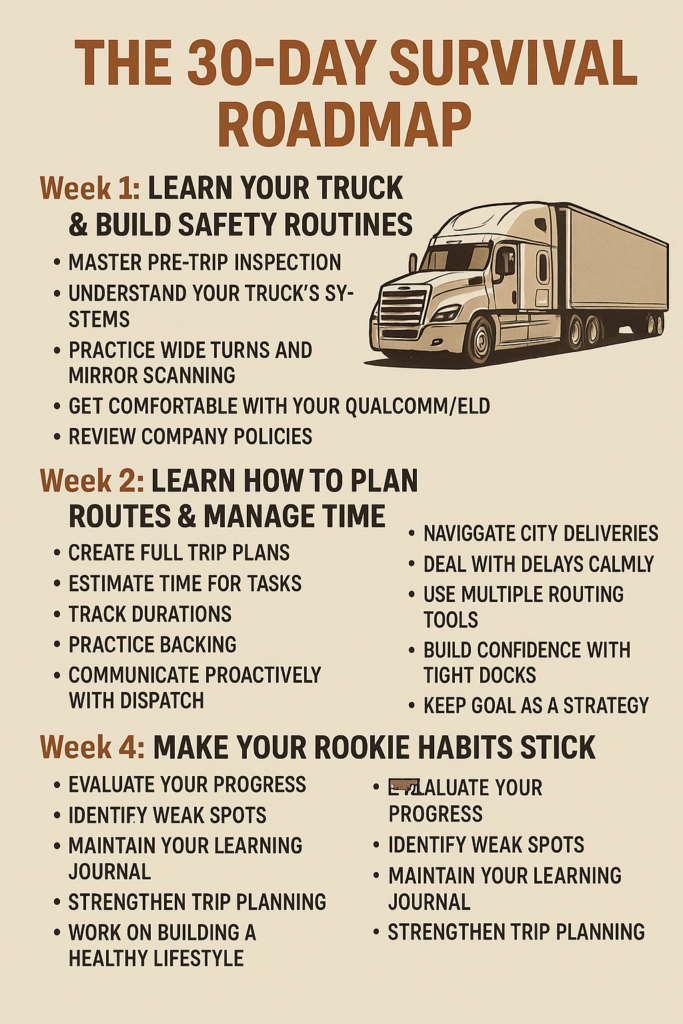
Week 1: Learn Your Truck & Build Safety Routines
- Master pre-trip inspection
- Understand your truck’s systems
- Practice wide turns and mirror scanning
- Get comfortable with your Qualcomm/ELD
- Review company policies
Week 2: Learn How to Plan Routes & Manage Time
- Create full trip plans
- Estimate time for tasks
- Track durations
- Practice backing
- Communicate proactively with dispatch
Week 3: Handle Real-World Challenges
- Navigate city deliveries
- Deal with delays calmly
- Use multiple routing tools
- Build confidence with tight docks
- Keep GOAL as a strategy
Week 4: Master Your Rookie Habits
- Tracking your progress
- Look for problem areas
- Diary your learning process
- Boost your trip planning
- Promote a healthy living
FAQ
1. Is the first month on the road really that different from what CDL school prepares you for?
Yes, indeed! CDL school gives you a template, but the first month practically forces you to use it while dealing with actual traffic, unpredictable customers, and the sheer weight of the loaded trailer you are ultimately accountable for.
2. Is it normal to make multiple mistakes in the first few weeks as a CDL driver?
Sure. Companies are prepared for newbies to take those initial steps. The most important thing is whether you slow down, question, and rectify the mistakes before they become habits.
3. How can a fresh truck driver avoid feeling swamped during the first haul?
Divide your day into small segments: one trip plan, one dock, one backing maneuver. When you narrow your eyes on the next secured step rather than the whole week, the workload becomes quite manageable.
4. Why do dispatchers stress communication that much in the first month?
Because they can only help you manage timing, delays, or tricky docks if they know what’s happening on your end. Quiet drivers often end up stressed out; communicative drivers solve problems in advance.
5. What is the major difference between a driver who will stay at the company and a driver who will leave the company early?
They embark on the daily tasks with the mindset of gaining more knowledge on different aspects of the job-a new parking angle, unload time, or a route that is more efficient. Step by step, the minor improvements make the driver believe himself or herself through and through.
6. What should a rookie driver take their personal development to be when they are not covering many miles yet?
In the beginning, lessen the driving distance. Focus on your good safety record, your punctuality, and whether your planning provides you with enough parking options. These are the real indicators of initial progress.