
Think about this.
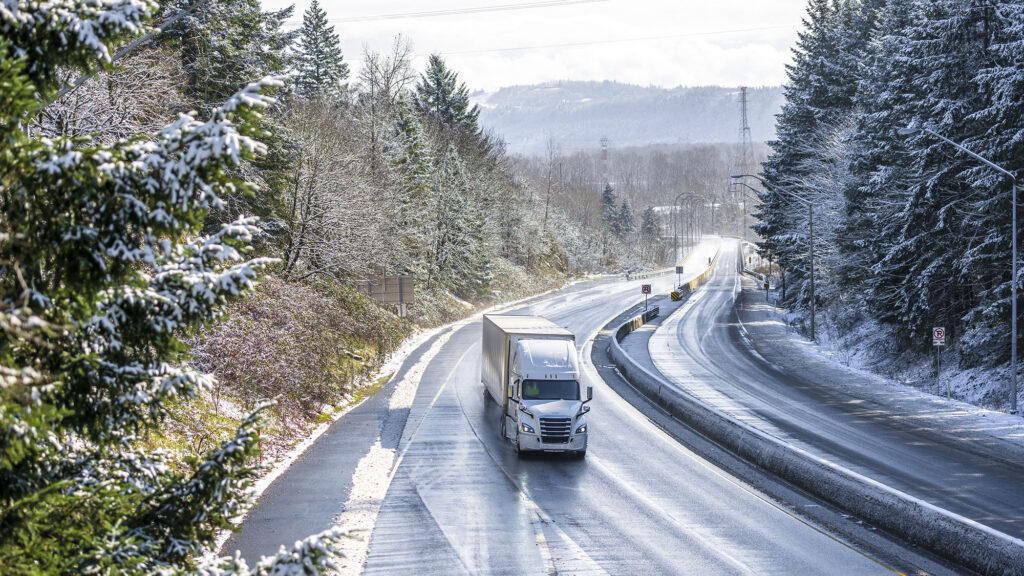
A freezing early morning, it’s 3 a.m. Driving through a maze of white, the swirling snow outside has transformed the windshield into a frame, while the road ahead resembles more of a suggestion than an actual line, and your right foot and your judgment are the only things standing between 40 tons of steel and a concrete barrier. You are exhausted, your dispatch is calling, the ETA has already slipped, and the thermometer has chosen its permanent abode below zero.
That is not just a theoretical scenario; it is the life of a winter trucker.
How To Handle a Semi Truck On Ice
Winter 2026 is not going to be merciful either. The weather is becoming increasingly unpredictable, leaving storms to not only emerge out of thin air but also to be the reason for the tightest always driving margin error in history. The good part: winter does not reward the show of bravado, it rewards you with the proper training and calm repetition. If you treat the season with the respect it deserves, and conduct every run as a serious military operation, you are loaded with a huge advantage.
This article is the ultimate in-depth guide written for all the hardworking truck drivers and fleet managers, who have only one goal; to see off the Winter 2026 season unscathed and with every team member healthy. We will start from the truck itself and move through traction, and the way you drive, to planning for the worst, and lastly, the most unexplored part in guides your focus, fatigue, and headspace.
In summary, you can break the winter safety process down to four key components:
- Ensure your entire truck winter-ready instead of simply filling forms
- Real traction instead of the so-called “legal minimum”
- Preparing your vehicle and body for delays, breakdowns, and mental stress
Fruit these three and you will be operating in less traffic than all around you.
Inspect Your Truck Thoroughly: Do a Winter-Grade Pre-Trip
Almost every driver has a set of moves to make before embarking on a journey, which have been so well entrenched into the muscle memory, that they can no longer forget them. Winter 2026 is the perfect opportunity to make some shifts. Instead of making things more complicated, your focus should be attention and the willingness to take a shift in your perspective: “What will I do if this happens on the coldest, darkest stretch of my route?”.
Check Tire Pressure and Tread Depth Like Your Life Depends on It
Traction starts at the exact spot where the rubber is in contact with whatever is pretending to be a road that day. During winter months, the distinction between “sufficient tread” and “barely legal” can be the difference between avoiding a hazard and crashing directly into it.
Tire pressure is low in the winter, the rubber becomes stiff, and little problems turn into big issues. The first thing that comes to mind is not good enough. You need a gauge, a light, and a couple of clean minutes for your conscience.
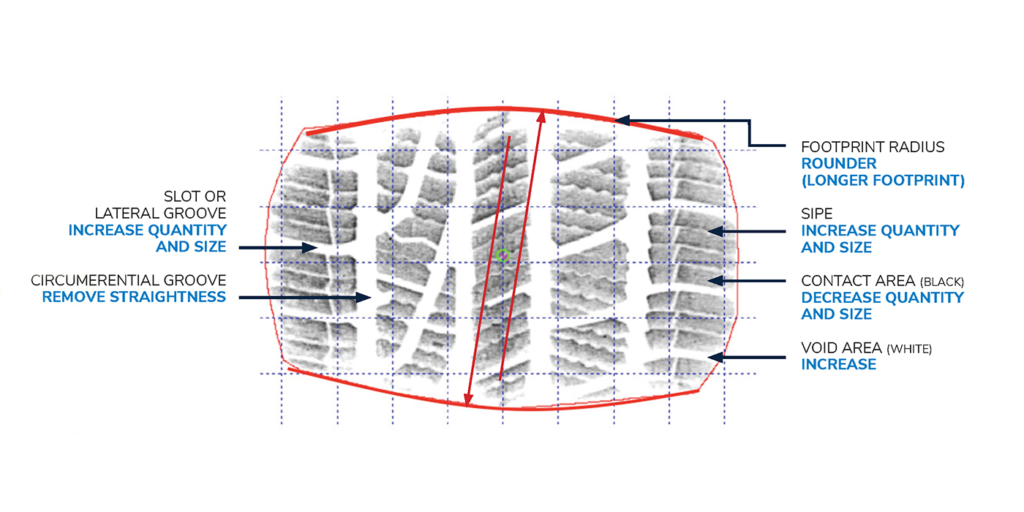
A simple way to think about it:
| Aspect | What to Look At in Winter | Why It Matters on Snow and Ice |
| Tread depth | Deep, even tread; no “bald shoulders” or visible wear bars | Deeper tread means more snow evacuation and grip; worn shoulders are the first to let go |
| Tire pressure | PSI checked when cold, adjusted to manufacturer recommendations | Under-inflated tires squirm and overheat; over-inflated reduce contact patch and lose traction |
| Sidewalls | Cuts, bulges, visible cords, damage from curbs or chains | Sidewall failures in winter often happen far from help in brutal cold |
| Matching pairs | Similar wear and type on duals and across axles | Mismatched tires can pull, hop or break traction unpredictably |
If you are tempted to squeeze “just one more month” out of a set of marginal drive tires, ask yourself whether that month is July or January. If it is January, you already know the answer.
Ensure Windshield Wipers and Lights Are Functional (And Then Some)
Winter is not only about hanging onto the bike. It is also being able to see yourself and having someone else to see you before situations get out of hand.
Wipers that were “okay” during the fall could be totally useless when the first ice-cold rains come down on the highway. Blades get brittle, they break, and they don’t get the glass cleaned properly. Windshield washer fluid which was fine when the weather was mild can freeze, and you are left with a dirty mix of salt, dirt, and ice that you cannot clear out.
Look at visibility as a full system rather than the sum of its parts.
| Component | Winter Check | Risk If You Ignore It |
| Wiper blades | No streaking, cracks or missed sections; full contact | Streaks and missed areas hide brake lights, curves and obstacles in heavy precipitation |
| Washer fluid | Winter-rated, topped up, lines free of blockages | Frozen or empty system means salt crust and mud stay on your glass |
| Headlights | Aim correct, lenses clean, both beams working | Poor illumination at exactly the moment snow or fog makes judging distance harder |
| Marker/tail lights | All working, regularly wiped free of spray and slush | Other drivers misjudge your length, position or braking |
| Mirrors | Clean, properly adjusted, heaters functioning if fitted | Lane changes and merges become blind guesses instead of deliberate maneuvers |
Basically, if you devote five extra minutes of your attention to glass and lights in the yard, you would not have any blind panic coupon for ten moments.
On this occasion, you are on a good spot to think well beyond the usual. Noticing the air system as it builds and releases, detection of any pulsing or pulling when you gently brake on a dry surface before hitting the serious weather, observation of how quickly the engine fires all these minor details are important. Stopping shoes, batteries, and liquids are hardly the weakest link on a mild sunny day; they are the ones cryptic for the coldest and the most isolated highway street.
Equip Your Truck with Winter Tires and Real Traction
After you finish checking the truck, the next question is just blatant: “If I do all things right as a driver, will the truck really stay on the road?”
Why Winter Tires and Tread Pattern Matter More Than You Think
It is one thing to say “all-season” and another to imply “actually wants to grip snow and ice.” In some milder climates, you may even spend the winter with rubber and good luck only. But on the roads with real winter conditions, this chance is exhausted quickly.
Winter or severe-snow–rated tires are manufactured using special compounds that remain soft at low temperatures and have special tread patterns that go deep into the snow rather than riding on top of it. That marginal mechanical grip that you get from this can be the difference in a stop at the traffic lights or in the case of the downhill curve just a slide that moves in slow motion.
If you are in the fleet business and thinking about buying tires for Winter 2026, here is a question to ask:
- Which of your trucks and trailers are usually confronted with realistic winter conditions, not only a few just frosts?
- Do the drive axles feature tires that are still “well above the threshold” of tread depth going into the winter season or are they just “technically legal”?
- Is there a rotating plan that allows fresher rubber-on-the-winter-heaviest work units?
Even if the best tires are not available all the time, you should see to it that the worst ones are not put on the most affected routes.
Understand Legal Requirements for Traction Devices Before You Are On the Grade
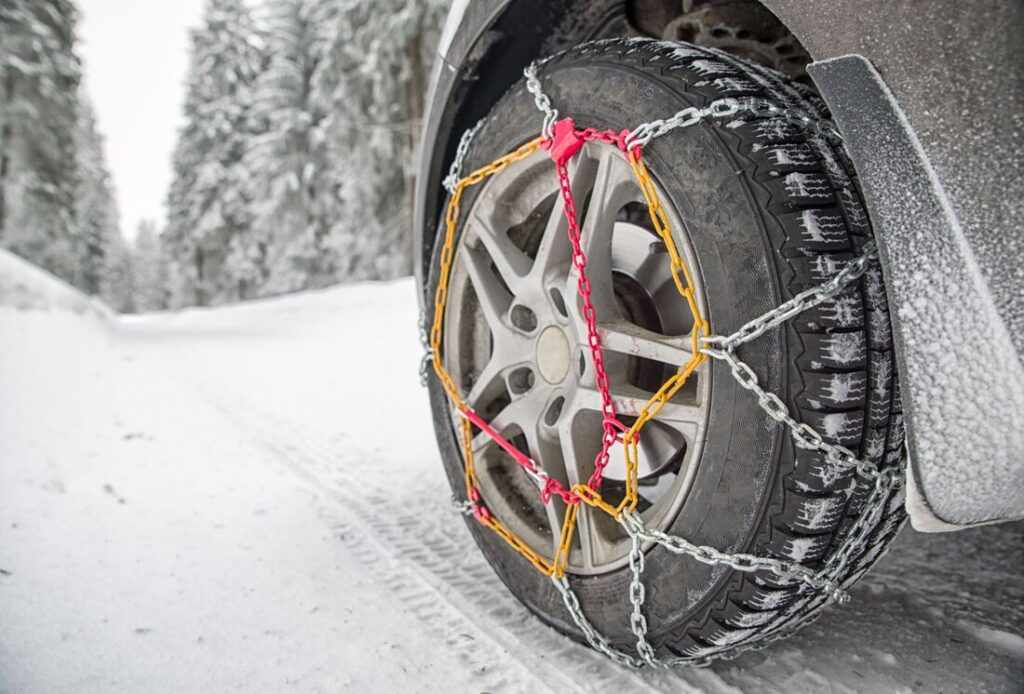
In a lot of places, winter tire traction is not just a matter of acting sensibly, it is actually a requirement by law. Specific mountain passes, certain highways and particular dates in the calendar are the ones that come along with chain requirements or specific traction rules for heavy-duty vehicles. Not adhering to these rules may lead to paying a fine; the most vital point is that it frequently results in one being stopped at a checkpoint or even turned back entirely.
The last time to go over the detailed rules on those conditions is when you are already stuck, with a massive snowstorm around and queuing behind a long line of unhappy drivers at the bottom of a steep slope.
This time, streamline the process and get the paper work done for winter 2026 ahead of time. This means getting information concerning:
- The areas where you must have chains, even if the road is not covered with snow.
- The places that you must put on chains when signs are flashing or are lit.
- The traction devices that are allowed on your routes and the equipment you have.
Just as vital as having chains is knowing how to use them. Practise putting them on a couple of times in a day-sunny and safe area. Find out how much time it takes you; discover which part of your body feels cold; know which gloves are effective and which are not. This one-time training can help reduce a massive amount of stress later when you are by the roadside, in the wind, and with cars spraying slush all over you.
Respect Weight, Balance and the “Empty Trailer Trap”
Truckers say that it is much easier to steer along a lopsided snow path with a full box than with an empty one, and this is not fantasy.In fact, a barely-loaded or empty full trailer will result in the drive axes of the truck being subjected to a balloon of pressure a lot lower than what they can bear. Less pressure leads to less friction. Therefore, when the same throttle is used, the test subject might not be able to keep up with the previous performance of the speaker and, instead, make the wheels slip.
In the Winter season of 2026, which is marked by the prevalence of erratic weather and poor road conditions, it would be wise to regard those cases as empty and very light loads as special cases. A lighter than usual acceleration is a must, coupled with, of course, a longer breaking distance and, also, an off-ramp, bridge, and a curve which are framed as “the worst until I see the surface being otherwise”.
The truck is the same, the driver is the same, the road is the same. The only thing that weight has changed is; but in winter, that one change is sufficient to change everything.
Adjust Driving Habits for Winter Conditions
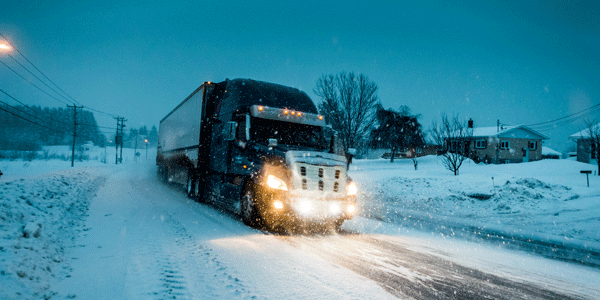
Preparation gets you to the gate. The real test starts once the wheels are rolling and the road surface stops behaving like you expect.
Reduce Speed and Increase Following Distance (For Real This Time)
All the safety lectures ask you to “slow down” and “leave more space.” Unless you don’t notice them anymore. Stop for a while, or take them literally, not only as slogans.
On an icy surface, your stopping distance can be several times more than on a dry pavement. Even packed snow can double your usual stopping distance. So the comfortable gap you keep during summer is not safety space in winter; rather, it is a countdown for you to reach the end of the road.
Consider three perspectives.
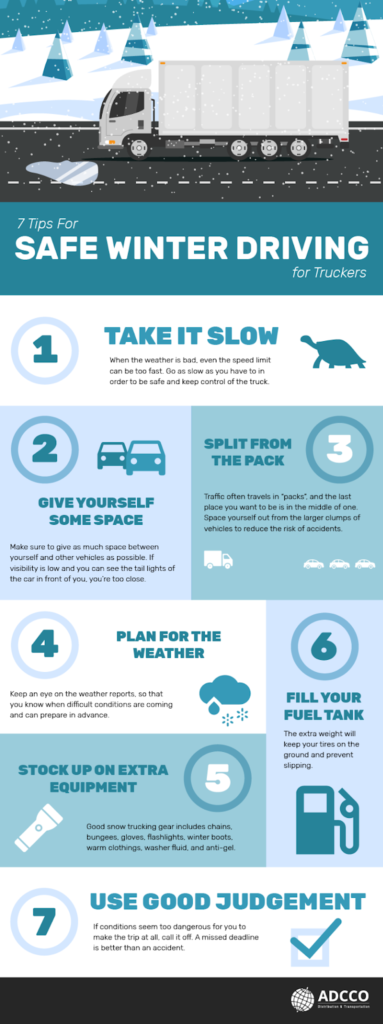
First, speed: the speed limit is posted for perfect driving conditions, not for icy rain. The road may appear “wet” but in actuality, it is starting to freeze. Reducing your speed by ten or fifteen kilometers per hour seems like forever when you are watching the clock, but it gives your tires the needed time and your brain the needed time to process what’s ahead.
Second, following distance: the nearer you stay to the vehicle in front, the more their mistake becomes your problem. In winter, absolutely double your gap and be prepared to open it more when you see brake lights flickering in the distance.
Third, lane discipline: changing lanes frequently means going back and forth between different wheel tracks, slush ridges and different levels of compaction. Each transition is a chance for you to make the rig move. Select a lane, make more space, and every sideways move should be treated as a slow, deliberate maneuver instead of a simple drift.
Winter speeding often doesn’t seem to be harmful. It feels “normal” until the moment you realize that the road has changed and you have no time to rectify it.
Use Brakes Strategically to Maintain Control
By having modern rear trucks, it is difficult to imagine their excellent braking systems, but they cannot change physics. The key to your job as a professional is more than just pressing the pedal; instead, it is to understand and manage the movement of weight in your vehicle.
On a slick surface, a sudden weight shift is your worst enemy. A sudden stop to the brakes may cause the steer axle to bear more weight than the pavement can cope, especially while turning. A late and hard brake to get off the exit may lead a trailer to skid while the tractor is still on the road.
Rather than waiting until the last second, consider braking like this: it is an early, gradual process. Cut throttle sooner when you observe brake lights or other indications of potential hazards. Start with light, gradual pressure instead of a heavy stomp. Use engine braking to help where the surface allows it, but know that the use of strong retarders on ice can be dangerous because they can lock the drive axle before you even touch the service brakes.
Exactly the same principle is your response on the case that something begins to go wrong. If you catch a trailer pushing you or a steer axle washing out, then a panic brake will just make it a lot worse. The best action is generally to off the pedal, turn the steering wheel straightforward and give a chance for wheels to grip again. It sounds counterintuitive for the first few times but with time and respect for the conditions, it will be like the second nature.
Read the Road Surface Like a Second Language
Winter roads should not only be classified as “good” or “bad” since they are variable on a minute-to-minute basis. They can sometimes change significantly while driving on the sides of the bridge. Almost all drivers who go through the most difficult times over the seasons master a habit: they do not limit their vision only to vehicles and signs but extend it to the road itself, figuring out what the state of the asphalt is like by the help of small signals.
These signals are from 2 places mainly: one is the road look and another is how other vehicles behave on it.
In terms of looks, a road surface that is dark, and shiny while the air is near freezing is a sign for you. The opposite is a case evidently where the structure of the matte finish gets irregular, shadows turn into street lights, or a bridge over the road is your way from the open air. The first things that freeze are the bridges and overpasses, because the wind blows cold air all around them, which takes away the heat much faster than the surrounding pavement at ground level. That is the reason the bridge deck can be slippery while the entrance is still just wet.
Relative to the traffic, one of the best tokens showing that the pavement is wet is tire spray. When you see that the cars in front of you are raising lots of water spray, you know for sure that you are probably driving on wet pavement. If, during a few minutes, the tire spray either decreases or disappears while the air temperature is falling or is at zero, this means that the surface is in the transition phase to form ice. You will notice it only when you try to brake or make a wild turn; and by that time it will be too late. Observing the substitute in the spray of the tires is your loophole to act in advance: slow down a bit, increase the distance of your following vehicle, and be much more careful.
You can never predict every road patch, but if only you start treating the road as an informational text you are always reading, not like just a road to drive on, you will have more time for your response.
Prepare for Emergencies: Assume You Will Be Stuck Once This Winter
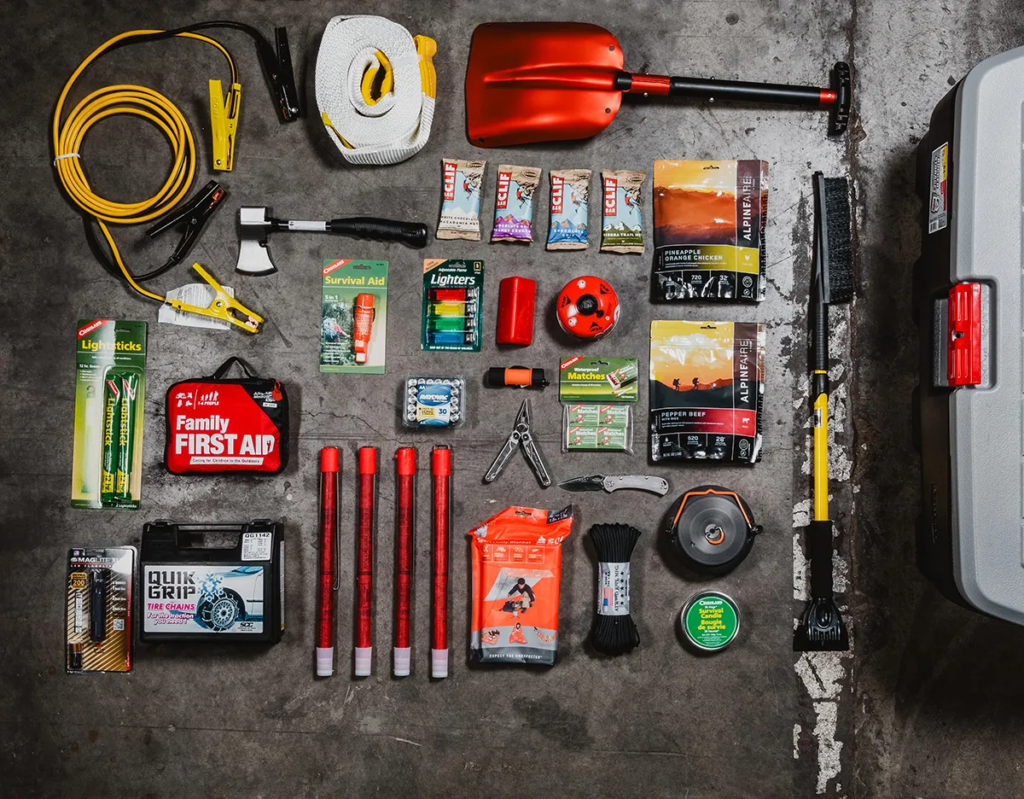
However good you are, and however cautious your company, winter has one more card to play: the unknown crash ahead, the surprise closure, the “just sit tight” order that lasts seven hours instead of one.
The difference between a miserable delay and a dangerous one is often measured in what you have in the cab.
Keep an Emergency Kit with Essential Supplies
An emergency kit is not a superstition or a corporate checkbox. It is the set of tools and resources that let you stay warm, alert and functional if the worst combination of events traps you in place.
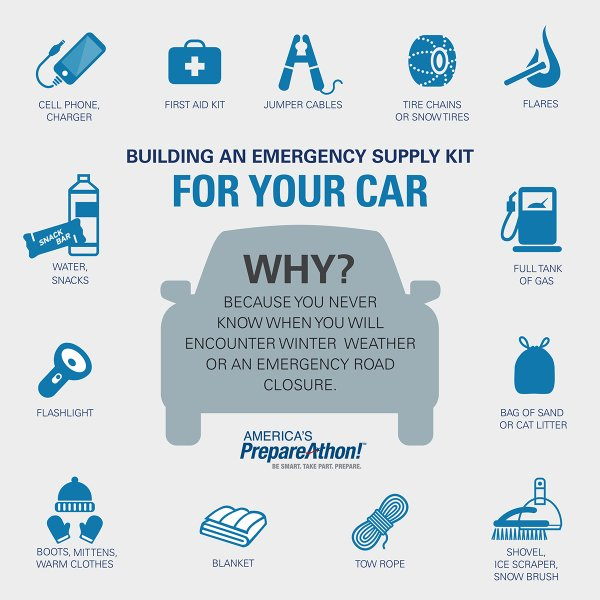
You can group the essentials into a few simple categories.
| Category | Examples of What to Carry | What It Buys You When Things Go Wrong |
| Warmth | Heavy blanket or sleeping bag; extra gloves, hat, socks, thermal base layer | Protection against hypothermia and frostbite if heat fails or fuel runs low |
| Visibility | Reflective triangles, hi-vis vest, headlamp or strong flashlight | Ability to be seen and to see while dealing with breakdowns in low visibility |
| Traction | Compact shovel, bag of sand or litter, traction mats if space allows | Chance to free yourself from light snow or ice without needing a heavy wrecker |
| Power | Fully charged power bank, spare charging cable, spare batteries | Ongoing communication and ability to call for help or check updates |
| Food & water | Non-perishable high-calorie snacks; bottled water or insulated container | Energy and hydration to think clearly during long, unexpected waits |
| Tools | Basic hand tools, duct tape, bungee cords, zip ties | Ability to make small fixes or secure loose equipment until proper repairs |
You do not need a survivalist warehouse in your sleeper. You need enough gear to stay safe and thinking straight for a day or two if everything that can go wrong decides to do it at once.
Stay Informed About Weather Conditions and Road Closures
Knowledge in winter is not just a gear but also a way to make yourself safe on the road.
You can check the weather report once before the journey begins, which helps a lot. However, this is not enough. The systems that move, the temperatures change that much faster than we can predict, and the small accidents may accumulate into the full-fledged road blockade.
Get in the routine of doing updates at every stop which means something to you. Look at the radar or road authority updates while you are gas station or coffee shop. Focus on not just your immediate area but also what is happening 100 or 200 kilometers ahead of you in the direction you are traveling. Notice similar things: if the way to your destination is getting worse and the way behind you is getting better that’s your sign to plan maybe to go earlier and stay for a while.
It is still important to know the radio along the way and to see the message signs. Apps can often fail when the coverage is not good; the road signs and the voices on the radio often are saying what the parking drivers and the patrol officers are seeing. If all three sides agree that the conditions are getting worse, you should trust them.
Maintain Focus and Avoid Distractions: Protect the Driver, Not Just the Truck
You might be using state-of-the-art gear and fitted with the best winter tires, but you will still be a potential road hazard if your mind is pre-occupied. Driving in winter is a cognitive burden. Nights get dark quicker while the view seems to be a dull gray and white and the anxiety about the road wears you out faster than a cruise in summertime.
Being Mindful of Changing Driving Conditions (And Yourself)
Distracting factors in winter are sometimes not only a cellphone or texting. In some cases, the mind just wanders off as the miles blur together.
Allocate a few minutes to self-questioning at regular intervals. Every fifteen or twenty minutes, think of these questions: Is my grip on the wheel getting tighter? Am I feeling impatient? Have the last few braking maneuvers taken longer than before? Has the wind picked up in the last half hour? Am I still scanning mirrors and instruments, or just staring at the spot ahead of the hood?
If the answers to those questions start to decline, that’s an initial indication that lost focus or changing conditions are happening. Deal with it while it’s just a hint, not a shout: slow down, create space, or maybe plan a stop earlier than you have planned.
The secret lies in avoiding surprises. The more you become aware of gradual changes, the fewer unexpected emergencies you have to deal with.
Frequent Breaks Lead to Less Fatigue
Everyone is mindful that resting is crucial. The winter months, however, make it much more difficult to disregard this rule.
Driving in cold weather and constant focus is like dealing with more stress than when driving in the summer when there is no rain or fog. You might still be awake in a technical sense, but your attention level would be lower than usual. Micro mistakes are sneaking in: a bit late with the response, not observing warning lights, or forgetting the details in mirrors.
Well, these short, regular breaks are not really a luxury. They are a safety measure.
Taking 10-minutes everyday, to step out of the truck, stretch, walk around, and inhaling some fresh air not filled with heating ducts is not a waste of time as you think. The simple act of changing your position will improve your circulation, energize your muscles and eyes, and sometimes even give you the opportunity to observe the weather that you missed through the glass.
It also has a psychological dimension: a break is a break in the monotony. You turn the long trip from start to finish into a series of small goals like the next rest area, next fuel stop, or the next hot drink. The journey becomes periodically achievable instead of a single long, exhausting push.
Eat, Drink and Wear Proper Clothes to Stay Efficient All Day Long
The food you eat and the drinks you consume do have as much impact on winter safety as the air pressure in your tires and tread depth.
Eating heavy, greasy dishes makes you sluggish and sleepy especially at the time you need to be more alert. Surviving on a diet of nothing but sugar and energy drinks only gives you a high that is followed by a crash at the right moment, namely when the road throws you a surprise.
Winter 2026 is the perfect season to embrace a food and drink strategy as part of your toolkit. Choose meals that help you to keep your energy for long periods: oatmeal, eggs, lean meat, beans, nuts, whole-grain bread, and hearty soups. Always keep within reach a more nutritious snack than candy: a handful of almonds, a fruit, or a strip of jerky.
The cold season is sometimes the easiest time to overlook hydration. Your thirst will not be as obvious as it usually is in summer, but the dry air caused by the heaters and the lower humidity will quietly drain the water from your body. Not drinking enough fluids can lead to irritability, headaches, poor concentration, and slower reaction times. One of the simplest ways to enhance your safety is to carry a bottle of water or a thermos of unsweetened tea during winter and sip from it regularly.
Clothing is the other end of the puzzle. Choose layers you can remove or add to. Starting out with a very warm jacket and then blasting the heater is a sure way to bring on drowsiness. Instead, be “comfortable cool” in the cab with the heater and have extra insulation, it readies you for when you step outside. That balance keeps you awake and protectsthe moment you open the door.
Winter 2026 Truck Driving Quick-Check Table
When you are getting ready to roll into serious weather, you do not always have time to reread a long article. Use the table below as a fast mental run-through before a major winter run.
| Area | Key Question to Ask Yourself | If the Answer Is “No”… |
| Truck condition | Have I checked tires, lights, wipers, brakes and fluids for winter? | Do a winter-grade pre-trip before leaving the yard |
| Traction | Do I have adequate tread, chains where required, and know the rules? | Delay departure until you are legal and equipped |
| Route & weather | Do I understand forecast and trouble spots on today’s route? | Recheck maps, passes and weather before committing |
| Driving habits | Am I mentally prepared to slow down and leave extra space? | Reset your plan; schedule only works if you arrive in one piece |
| Emergency prep | Could I stay safe for 24 hours if stuck where I am going? | Stock your kit and refuel before heading into marginal areas |
| Focus & fatigue | Am I rested, fed, hydrated and focused on the road ahead? | Take the time now; it is cheaper than a mistake later |
A Final Word Before You Point the Hood Into Winter 2026
Winter is not concerned about the number of miles you have driven or how excellent your safety report is. It does not mind how pressed the delivery is, how fiercely the customer yells, or what the incentives look like. What winter values is obedience to its rules: monotonous, non-fancy, repeatable actions that prevent you from entering circumstances that other truckers find themselves in. Pass the winter-grade test with flying colors even when attendance is optional. Push for the proper tires and grip equipment. When the temperature is close to freezing, safely drive at least ten or twenty kilometers per hour under the ‘normal’ speed you would feel. Assemble a few strong and simple external kits. Care for your mental and physical well-being just as fiercely as you care for your vehicle. Perform those tasks every trip, every storm, and Winter 2026 will be a different occurrence: not a challenge but a period of time that you pass through as a real professional, prepared for everything it has in store and above all, determined to make it back home.
❄️ Winter Driving Tips for Truckers: Stay Safe on Icy Roads!